FAITH QUAKE

FAITH QUAKE

What a faith earthquake we’ve been through this last week. I’ve had more people reach out to me with hurt, pain, anger, and doubt in their faith than any other week ever. I can’t think of any single event in my lifetime that caused such a faith-crisis in my immediate friend-circle and beyond. And I feel it too. I’m carrying the weight of my own disappointment and frustration.

The church has lost a lot of credibility with many people (and for some it didn’t have a lot left) and I fear it will take a long time to earn any of it back. Large portions of the evangelical church will never earn it back. We’ve likely witnessed the “final straw” event for many people in their relationship with church.

Of course it had to do with the election. But not because a “republican” got elected. This isn’t about normal republican/democrat debates.  It’s not about thinking that Harris was the “Jesus” candidate. Anyone who assesses the fallout of this faith crisis as just liberals crying over a political loss won’t ever understand why people are leaving the church and will have no hope to rebuild credibility with them. 

People aren’t leaving the church because they identified Kamala Harris with Jesus and she lost. People are leaving the church because they saw the church identify hate, indecency, cruelty, racism, sexism, sexual assault, insurrection, and crude public sex jokes with being the champion of Jesus. They saw the church not just hold its nose and vote for a person in spite of that message (which might be bad enough), but in many cases give it a full-throated endorsement! They saw a church that wanted the “strongman” and felt justified in his cruel tactics, often cheering it on. 

People aren’t dumb. They know “love your neighbor” and “love your enemies” doesn’t look like that. They hear evangelicals talk about Jesus and how morals and character matter, but they no longer trust that evangelicals actually believe what they say. And why should they? 

Evangelicals may have mobilized to win an election, but they’ve lost their credibility to speak in any meaningful way into the lives of most of their neighbors. It’s why I mourn and lament. Not simply because I’m sad about what this election cycle means for our country, but because of how much damage it has done to the Christian witness. 

Those of us left who do want to advance the message of the peaceable, loving, compassionate Jesus have a lot of work to do. But at least the winnowing work has been done. The civic religion that often co-opts Jesus’ name has been exposed. We won’t have to do much work to distinguish ourselves from it anymore. Demonstrating basic love, decency, kindness, and compassion will be all it takes. It will stand it stark contrast to what passes as “Christianity” in most places today. And once the ground stops shaking as badly, I hope it’s a safe place for many to put their feet as they start to rebuild. 

So to those of who you who have been through a disaster zone this week, we see you. There are those of us who feel it too. We carry your hurt along with our own. And whenever you are ready, we are ready to join you in clearing out the rubble, picking up the pieces, and rebuilding something new.

My Post-Evangelical? Era

My Post-Evangelical? Era

It’s been a tough week for me and many of us. Apocalypse usually is that way. Apocalypse is simply an old word for “revealing” or “unveiling.” It’s the idea that something is made known to us fully that we didn’t see completely before. It’s like a curtain that goes up and we see what’s been behind it all along but didn’t have eyes to see. It feels like that happened this week in my religious world. The curtain went up and what many of us saw was worse than we expected or feared.

So, to those of you who follow Jesus and feel betrayed by the church that taught you about him . . . I understand. I feel those feelings too. I know what it’s like to be an exile from the faith that nurtured you. It hurts. It feels like grief, anger, and betrayal all wrapped up into one. It makes you question everything you’ve believed and the people that taught it to you. I get it.

But you are not alone. There are many of us out here. We feel what you feel. 

Weirdly, I find comfort and encouragement by your discontent. It reminds me that the love of Jesus can still be recognized even though a large part of the American evangelical church has been co-opted for other purposes. 

Many of us are not ready for a “what’s next” discussion. Coming to grips with the reality of our situation is difficult and requires a moment for lament. I’d encourage you to take all the time you need. No need to rush the grief or express simple platitudes of hope. It’s okay to feel the hurt for a bit. It’s okay to grieve. I certainly have been.

But, whenever you are ready (and if you ever are) . . . let’s begin a new way. 

For those of you who know me well, it won’t surprise you that I haven’t been comfortable in American evangelicalism and the small non-denominational tradition within it that has been my home for a long time. I’ve been deeply concerned about its preoccupation with coercive political power and its narrow and excluding theology since before it was cool point that out. I’ve been very vocal about it for years, hoping and urging it to reform. But I can no longer ignore the unique harm it does to the witness of Christ and to the lives of my neighbors. It has continued to reaffirm its own choice of what it wants to be, and I must make my own choice of what to do in response. I want to leave that label behind. If you are reading this, you probably do too.

I feel a sense of gratitude for the church I grew up in for first introducing me to Jesus and there are many things from that tradition that I’ll take into the future with me. But I can’t claim whatever the label of “evangelicalism” means today. It’s got so much baggage. And I’m tired of defending it and trying to reform it. We need a post-evangelical movement.

I don’t mean post-Christian. I’m not abandoning faith in Jesus. Rather, it’s because of Jesus that I feel compelled to find a new way. I’m not giving up on church as a community either. I still find a healthy church community to be hugely formative and supportive in my faith. But we do need a new expression of church beyond what is commonly called “evangelical.”

“Evangelical” is a term that is hard to define. In a certain way it just means “according to the teaching of the gospel.” And I certainly still affirm that as meaningful to my life and faith. But more popularly, “evangelicalism” has come to mean a certain type of American church that is preoccupied with conservative politics and fundamentalist theology more than the first definition. It’s that latter meaning and those type of churches I mean to depart. Truthfully, I left them in spirit long ago, but the association still remains. Today I want to make it clear, I don’t want to be associated with that at all. I’m done with all that. We need a new way forward.

I know for many my written disassociation here is not far enough. Some will find they need to pursue paths outside of the church altogether. I understand that position too. I can appreciate the intention to follow Jesus outside of traditional church environments these days and understand why some will.  

But for me, I believe there is something new on the horizon. And I’m not alone. I’ve found all sorts of people looking to forge a way forward. I’ve met some beautiful people who are Lutheran, Presbyterian and Catholic who feel the need as well. They recognize the church is off track too and want to find a better way. I think they’ve got a lot to teach me about how to go forward. Maybe we need to learn from each other. And maybe together we can forge something special in this post-evangelical landscape.

As hard as these past few days (and years) have been, perhaps we’ll experience another apocalypse in the days to come. Maybe another curtain will be pulled back and we’ll see there are more people ready to make a jump to post-evangelical life and that we aren’t the only ones needing to leave the church as it currently exist. I hope maybe you’ll catch a glimpse of that revelation just in reading this. You aren’t alone.

I’m not ready to give up on church, but it must look like something different, or I can’t continue in it either. I’m ready to explore what’s possible next. And if—at some point—you find yourself interested in taking a new journey too, just know you are not alone and there are others of us out here. We’d cherish the companionship as we look to build something new, and that you are always welcome to join along as we figure this out together. 

The comfort and peace of Jesus be with you.

The Call to Controversy

Need something stimulating to think about?

You could hardly go wrong with Brian McLaren’s new book, “A New Kind of Christianity.”

This book is certainly continuing to stir up not only healthy dialogue about important topics of faith, but also controversy in the Christian arena. It seems that there is very little middle-ground of opinion in regards to this book. People tend to either love it or hate it. And like it or not, in Christian circles this book looks to be THE “most talked-about” read of the year.

So, why endorse something that is the source of such controversy? Well, for several reasons:

1) WE NEED TO BE AWARE OF THE DISCUSSION.

Lots of people will be talking about this book and the questions that it raises. And make no mistake, they are important questions, no matter what you think are the correct answers. These are the questions of 21st century Christianity; questions of both those inside and outside the mainstream church today. Whether you realize it or not, you will be a part of this discussion. In fact, your voice will help shape this discussion.

And let me suggest that you actually read what is being stated by this intriguing side of the discussion. I have and will continue to read many disparaging comments and blogs about Brian McLaren’s view from people who disagree with his answers, which by the way is just part of the healthy dialogue. But, what is not healthy is that many of the people on the opposite side of the debate have not actually read McLaren’s books.

“That Brian McLaren has really gone off the deep end. I think he’s dangerous.”
“Have you read his book?”
“No, but I’ve heard he said such and such.”

Brian McLaren

Maybe we ought to be a bit more informed as we enter this discussion. Whether it is McLaren or MacArthur, maybe we should actually LISTEN to what they have to say and the context in which they say it before we criticize them. In fact, while you may disagree with either person in many areas, you may find some common ground as well. Or perhaps even more importantly, you may disagree with the conclusions, but may find a respectful appreciation for the spirit of the person and their questions.

In a recent interview, McLaren makes a case for this in responding to the way people easily dismiss his questions as “liberal” without considering his possibly more complex stance:

“I wouldn’t want to overlook the many ways in which my proposals differ from traditional liberal theology. My attitudes and commitments regarding Jesus, the Holy Spirit, scripture, spiritual experience, institutionalism, personal commitment and conversion, evangelism and discipleship, and many other subjects make many of my liberal friends think of me as conservative. Sometimes I wonder if evangelicals simply use the word “liberal” as a way to say, “Let’s stop listening to this person. He’s too different from us, and so is not worth our time and attention.” I hope that’s not the case, but sometimes, this is what I feel like when evangelicals use “the L word.”

For me, liberal is not automatically a bad word. If liberal means free from tyranny, I’m for it. If liberal means generous, I’m for it. If liberal means believing that our best days are ahead of us, I’m for it. If liberal means welcoming honest questions and giving honest scholarship a fair hearing, I’m for it. If, on the other hand, liberal means without restraint, or careless about tradition, or dismissive of scripture, or institutional and lukewarm regarding commitment to Christ, and so on, then I wouldn’t want to be associated with that. And we could say parallel things about the word conservative.”

Huh, maybe he’s not as crazy as people say. But, that’s not important. You don’t have to agree with McLaren, but maybe we should give him a fair-hearing (or rather reading). It may be that he is not as “off-the-deep-end” as we think. Or even if he is, that he is at least still committed to the best of his mental and reasoning ability to Jesus, if only incorrect.

2) WE NEED TO BE THINKERS

What I like best about this book is that it forces us to wrestle with concepts we take for granted and THINK. Controversy can only exist where people are seriously grasping and thinking and reasoning. And in that way, a healthy dose of controversy is probably very good for the modern church.

I work with high school students on a regular basis, and by far my greatest goal in my time with them is not to give them all the answers. Do I want them to have good answers? Of course. But more importantly, I want them to learn HOW to question, HOW to find good answers. I want to help them learn HOW to THINK. Many more questions will come up in their lives long after I am gone, and I’d rather they learned how to critically think about those questions sure-to-come in the future rather than just have some spoon-fed responses from me about the ones they are asking right now.

Ironically, many high schoolers I know are better at wrestling with questions and learning to think than a lot of adults. And maybe that is a bigger problem in our churches today than we’d care to admit. We just don’t think for ourselves. We’ve accepted long-held answers (many of which might be correct, by the way) to many old questions (some of which people aren’t asking anymore) without ever thinking it through ourselves. We are lazy. Lazy theologically. Lazy mentally.

This has direct consequences for our witness to the world. Because while we are busy being content with answers to questions we’ve never genuinely asked ourselves, the rest of the world is actively and honestly seeking answers. The church is irrelevant because by and large we can’t speak authentically to these questions. We appear to be a second-hand, consignment store of truth because we are primarily selling the “hand-me-down responses” of generations before us rather than doing the hard work of wrestling with the deeper questions and making sense of them in this time and context for ourselves.

Consider just these few questions: How is the Bible unique and why should it apply to my life? What makes the Bible authoritative in my life? How do I know it is the “Word of God?” What does it mean that it was “inspired?” What in the Bible is culturally-conditioned for people at the time of it’s writing and what is a universal-truth that applies to me? How do I know the difference? Can I know the difference? Is there a difference?

While just the tip of the proverbial ice-berg, these questions alone go a long way in helping answer modern dilemmas such as human sexuality, the character of God, the purpose of Jesus, social justice, and other ethical considerations.

Some will agree with the conclusions of the author and others will not. But no matter what you think of McLaren’s answers, what is undisputable is that these questions need to be asked. Or rather, these questions are already being asked by many people (friends, family, co-workers) around us. McLaren is not by far the first person to ask these questions, but he is suggesting that rather than dismissing the people who ask them maybe we ought to spend some time struggling with them as well and as a community “led by the Spirit” recalibrating the answers to this time and in our current context.

As McLaren says:

“That’s why, in the end, I hope people will actually read the book with an open heart and mind. I’m not expecting that anyone will agree with everything — that’s not my point. But I am hoping that people will be stimulated to think, and maybe even to dream of better possibilities … so the Christianity of the future can continue to learn and grow and not simply repeat the past or be stuck in the present.”

Is it dangerous to read a book that challenges things that you believe and causes you to ask some rather unsettling questions about your core beliefs? Possibly. But far more dangerous for the church today is not reading these books and not asking these inquiries.

So go ahead and risk it. It’s okay to hang up the “under-construction: please come back later” sign on your theology for the weekend. Pick up the book and let it mess you up a little bit. Be okay to let the questions move you to a place of uncertainty for a while. Inhale the ambiguity and breathe deep the tension of inquisition.

It may be that once the smoke and fog has cleared you find yourself with some “real” answers. Or at the very least, a greater understanding & compassion for and a stronger, more respected voice into the life of seekers around you.

It could be the church will be healthier for the controversy.

Would Jesus Make You Buy Health Insurance?

“What is the Christian response to healthcare reform?”

Facebook & Twitter are great for those kind of trap questions, aren’t they?

An incredibly complex topic (does anyone really know all the ramifications of reforming or not reforming?) about a controversial American bill (does anyone really know everything that is in this thing?) and you’ve got 140-characters to concisely explain the Bible’s definitive view (does anyone really know what 1st century Jesus & his disciples would actually think about 21st century American healthcare?) on something you’re really not sure about.  Hahaha… classic.

And yet, I’ve found myself answering this and a bunch of similar questions online a lot this week.  Really, they are the questions I’ve been asking in my head too, struggling to formulate an opinion.  Questions like:

“What is the Christian view of healthcare reform?”

I’ve read literally dozens of articles and blogs in recent days seeking to answer this very question.  Some people say that when Jesus said, “Love your neighbor as yourself” that he had this type of idea in mind: a society that progresses and values those who have more giving to those who have less.  Jesus, they say, would be all for this type of bill.

Other people use the same quote from Jesus to explain that he meant uncoerced, self-sacrificial love, not compelled assistance of those around us.  Jesus, they say, was not discussing government intervention, but individual generosity.  Clearly, Jesus would be against this type of bill.

“What would Jesus say about healthcare reform?”

He’d love it!  He’d hate it!  He compels us to support it!  He demands we reject it!  The views out there are strong, compelling and fairly exhaustive.

I can literally scroll through the newsfeed on Facebook and place people into their camp.  I read status updates like:

“healthcare reform is a sign of the end times.”

“win for Jesus, as healthcare reform passes.”

“I’m moving to Canada…wait… ughhhh”

“should we rename Reagan International Airport after Obama or Pelosi?”

I mean, who needs a USAToday poll about what people think when I can just read it on Twitter?

Now, of course, everyone’s got an opinion.  I myself have an opinion.  But, it turns out that Jesus has the same opinion we do too.  Whether we are pro-reform bill or anti-reform bill, it appears that Jesus is too.  We quote Jesus and explain our correct theology and justify why Jesus is on our side and not on the other.  But the reality is, either Jesus has gone schizophrenic or we have.  And one way or the other, God has some serious mental illness in his family.

“What do YOU think about healthcare reform?”

Maybe that’s a better question.  I’m not trying to ride the fence here and take the easy way out.  I’m not gonna say I think both sides are right and try and appease everyone.  I definitely have an opinion on this topic (however ill-informed it may be).  But, let me just OWN it.  It’s my opinion.  I don’t know what Jesus thinks.  My politics aren’t necessarily Jesus’ politics.

I formulate opinions based off what I believe to be true about Jesus, but as with many things in life, I operate out of faith and in environments where I don’t see clearly.  I stumble through decisions and opinions, praying they reflect Jesus heart, but sometimes unsure; many times evolving and changing as I learn and grow.

“What does Nick think, right now, about healthcare reform?”

I’m in favor of this healthcare reform.  I think its good for a whole lot of reasons that many other people have at great length explained.  But, I’m not writing this to convince you to agree with me or to argue that Jesus does.  In fact, I’m hesitant to say what I really think for fear it will come across that way.  I’m only saying what I think to show I’m not neutral.  I have an opinion.

But, it’s MY opinion.  I don’t speak for Jesus when it comes to politics.  No one does.

Does Jesus have a strong opinion about healthcare reform? Maybe.  But, he hasn’t ever told it to me.  I have absolutely zero words from Jesus (in the Bible or audible discussion) addressing the specific topic of the American healthcare system in 2010.  Everything I think and endorse in this arena is at best my limited view of what I “think” Jesus would approve of, and I’m completely open to thinking that possibly Jesus doesn’t really care one way or the other.

“So, Jesus isn’t on either side?”

Actually, I think it is a bit more profound than that.  Jesus is on BOTH sides.

As I scroll through my Facebook newsfeed I see many good people that I call “friends” outside a computer screen who deeply love and try to follow Jesus.  And as I divide them into their pro and anti reform bill categories, it occurs to me that I don’t have the market on Jesus any more than they do.

My anti-reform bill friends are trying their best in their experiential framework of life to reflect Jesus in the same way that I am with my framework.  We both agree that Jesus says, “Love your neighbors as yourself,” we just have different conclusions about what that looks like in Seattle, Washington in 2010.

When I claim Jesus is on my side, I’m right.  But so are they.

Will we ever agree on American politics?  Probably not.  But maybe we don’t need too.  Maybe we just don’t need to make Jesus agree with us either.

McLaren Q2: The Authority of the Bible

How many Owner’s Manuals have you actually read all the way through?

Yea, me either.  In fact, I’ve got a whole drawer full of owner’s manuals that we keep in case we need them.  If it was up to me, I would have thrown most of them away long ago.  But, my wife is much smarter and more thorough than I am and keeps them filed in case the dishwasher ever breaks down and we need the document that tells us how to fix it. (Not that I could do it anyway).

So, they sit in a file.  They don’t help me with my day-to-day life.  Most days I forget they are even there.  They are just kind of an emergency reference I can pull fix-it info from if things don’t go as planned with appliances I take for granted.

In a similar way, I often treat my Bible that way too.  As a teenager, many well-meaning people told me that my Bible was like the Owner’s Manual of my life.  It told me what to do, what not to do and how to fix what was wrong.  And while there is certainly some direction in these areas, I have discovered in reading the book that its description as a Manual is quite poor.  The collection of material in Scripture is much more complex than this.

What’s more, this view of the Bible has lead to me treating it like a Manual. Most often, I’ve left it filed in the drawer, inapplicable to my daily life, ready to pull out and scan for a nugget of “fix-it” advice when necessary.  Too easily the manual is left unread or if finally read, read poorly, too simplistically and ripped out its natural context and applied incorrectly.

In this second interview with www.theooze.tv, Brian McLaren speaks briefly about how we might re-frame our view of Scripture.  Instead of the metaphor of a Manual, he employs the picture of a legal-document (or constitution), which is another common well-meaning but misguided view of the Bible.

Just another addition to his new book, “A New Kind of Christianity.” A good source of enough thought-provoking material to open a dialogue.  Watch the video and leave a comment to join the conversation.

McLaren Q1: The Narrative Question

Looking for a good, open conversation about faith?

Well, our friends at the conversation-starting website: www.theooze.tv are currently doing a video series with Brian McLaren about his new book: “A New Kind of Christianity: Ten Questions that are Transforming the Faith”.

Each video features McLaren discussing one of the specific questions raised in his book.  And, due to the subject matter, I’m sure there will be much conversation generated! And really that is the goal.  There may be more than one thing that you find yourself at odds with him about, but according to McLaren himself, these questions:

“are not intended as a smash in tennis, delivered forcefully with a lot of topspin, in an effort to win the game and create a loser. Rather, they are offered as a gentle serve or lob; their primary goal is to start the interplay, to get things rolling, to invite your reply. Remember, our goal is not debate and division yielding hate or a new state, but rather questioning that leads to conversation and friendship on the new quest.”
(Brian McLaren)

So, here is the first of these videos.  It discusses briefly, McLaren’s first few chapters on the “storyline” of the Bible and how to properly frame our picture of Jesus.  Give it a quick view (less than 5 minutes) and feel free to comment here on your thoughts or go to www.theooze.tv and watch them all as they become available.

Are Long-Nose Genes Recessive?

I think I’m in the 80th percentile of nose length for humans.

Okay, maybe 85 percent . . . I’m definitely helping bring up the average.

Loyd Family 2009

So, you can imagine my excitement as I see my daughter grow up and realize that I think she’s inherited her mother’s genes for that particular part of her facial structure. Either that or my genes have just been diluted with the smaller nose genes of my wife, which has some how diminished the long-nose genes I was contributing. Kind of like going on a long, healthy run and then indulging in a deliciously caloric Chick-Fil-A binge; they just cancel each other out.

Or, Paytyn is adopted. But, if that’s true, I wanna know what that heck that thing was I saw come out in the delivery room!

Anyway, it seems as though my daughter is not inheriting at least one unfortunate part of my physical makeup. Now she just needs to find good teeth, sturdy tendons and a little more height from some other branch in our family tree.

It’s funny the things that we pass onto our kids, isn’t it? I was watching Paytyn laugh and play the other day, her golden curls bouncing in her face and her eyes alight with joy and I could see in her face the beautiful outline of her mom. In other moments I see the slightest resemblance to her Nana (grandma). And, I’m told that she has a certain sarcastic expression that looks like me (figures).

She is made in our likeness.

Paytyn Loyd

She looks like us. But not exactly. Paytyn is a strangely inimitable mixture of my features and the elegant characteristics of my bride. And that’s the thing about “likeness,” it’s not a photocopy. It’s a likeness. She looks like each of us, at various moments, but at the same time she is her own unique recipe of person. Like a blend of coffee that tastes so familiar and yet has traces of flavor you can’t quite place.

So, in the first book of the Bible, the writer records that God made us in His likeness.

“When God created man, he made him in the likeness of God. He created them male and female and blessed them. And when they were created, he called them ‘man.’”
(Genesis 3:1-2)

Created in the “likeness” of God.

Think about that for a moment. Every one of us carries in us some sort of divine imprint or substance. We are made of God-stuff. From day one, we are inherently birth-marked by the beauty and goodness of the Creator. Knowingly or not, we exist and move and breathe with what amounts to the DNA of God that gives us life. It is with God that all our genetic material finds its origin and it is His genes that flow freely through all the family trees of humanity.

Daddy's Monkey Face

Try remembering that next time you feel ordinary. To be human is to truly be more than just a mundane collage of cells, but to be made in the image and likeness of God.

We are not God. He is unique and strange and wonderful. But we are “like” Him. And His icon in us makes every one of us beautiful, exceptional and invaluable.

Now, my worry for Paytyn is not this amazingly divine heritage, but her more earthly one. Because you see, it’s not just that she inherits the “likeness” of God in her genetic makeup, but also the “likeness” of me in many areas of her life and personality. Read the very next verse in Genesis:

“When Adam had lived 130 years, he had a son in his own likeness, in his own image; and he named him Seth.”
(Genesis 3:3)

For better or worse, for long or short noses, we also create our kids in our own image. The things that haunt us, often haunt them. The things that plague us, frequently make them sick too. And the many inadvertent examples we live-out become their learned patterns for life.

Her future is so bright...

You can be sure that Adam already knew this. Because of Adam’s big mistake, his first two sons learn the art of sin and the one kills the other in the first murder in the Bible. Seth, whose name means “appointed” or “compensation,” is born as a “replacement” for the lost son. Talk about a lot of pain and hurt to inherit.

Made in the image of God, but born into the fallen pattern of Adam.

Such a strange mixture of beauty and tragedy we all are. Like an otherwise beautiful and healthy body that is dying from cancer. We are like God. But, we are also like Adam. At least for now.

Often times now, I find myself wondering which Paytyn will inherit from me more. The beautiful goodness and compassion of God? Or the messed up, mistake-driven selfish patterns of me?

You see, I know God is re-making me. Almost as if He is, through Jesus, working to re-write the uncorrupted file of His DNA back into my life. For though I am made in the “likeness” of God, Hebrews states that Jesus is the son who is:

“the radiance of God’s glory and the exact representation (image) of his being.”
(Hebrews 1:3)

Jesus isn’t the “likeness” of God, He is EXACTLY GOD. He is the purest expression of God.

And though he is working to help me unlearn patterns of my selfishness, I still struggle in my paradox; struggle that will inevitably bleed into the inheritance of my daughter. I just hope that Paytyn grows up seeing the incredible progress He is making in me and not just all my mistakes along the way.

Nick - Paytyn - Tania

Though I will try my best, unfortunately for Paytyn, she might have been better off with a long nose than some of those other characteristics I’m sure to pass on.

Somebody asked me the other day, “So does your daughter look more like you or Tania?” And really, I’m not sure. There seems to be a good compliment of us both in her.

I guess until she gets a little older we won’t know for sure which nose she actually inherited. I don’t know which of us she’ll end up looking like more.

But, just between us, I pray she looks a lot more like God than either of us.

.

When My People Prey – (Part 1)

I’m really excited to introduce to you today an exceptional guest who will be helping us in our discussion on “Jesus and Non-violence”!!

n1629356414_162991_2311192

Dr. Brad Cole & family

This is Dr. Brad Cole and he is going to be assisting us in understanding how to make sense of all the violence we find in the Old Testament; a tough topic whether you are a pacifist or a “just-war” proponent.

Brad and his wife Dorothee are both neurologists and he is the course director for the 1st and 2nd year neuroscience medical students at Loma Linda University.  Brad has a weekly bible study with the medical students. The video and recordings of this can be found at www.godscharacter.com. You can read his full bio HERE.

logo

Check out Brad's website HERE!

Because this topic is such a vast one, Brad has put in a great deal of effort to be thorough and I think you will appreciate the result.  However, because of the length, we will be breaking his essay into TWO posts.  And though it is a bit of reading, I promise you will not be disappointed.  Brad has a lot of answers to the questions that many of you have asked.    Welcome to the conversation, Brad!

——————————————————————————————–

“Come and see what the LORD has done. See what amazing things he has done on earth. He stops wars all over the world; he breaks bows, destroys spears, and sets shields on fire. ‘Stop fighting,’ he says, ‘and know that I am God, supreme among the nations, supreme over the world.’”
(Psalm 46:8-10)

gq

click here to see the full slideshow

Many read the Bible and conclude that there are legitimate situations that call for a violent response. In fact, many have quoted scripture to support violent actions and we don’t need to go back to the Crusades for examples of this. Just last month it was revealed that Donald Rumsfeld extensively used Bible quotes in his daily briefings to George Bush with regards to the Iraq war.

These included “rah-rah” photographs of American soldiers with captions such as “Therefore put on the full armor of God…” (Eph. 6:13)

Another photo depicted soldiers kneeling in prayer next to the words, “Whom shall I send, and who will go for us? Here I am Lord, Send me. ”  (Isaiah 6:8)

And finally there was a picture of Saddam Hussein next to the verse, “It is God’s will that by doing good you should silence the ignorant talk of foolish men.”  (1 Peter 2:15)

At the same time, however, it seems to me that there is a recent ground swell of individuals who believe that the Kingdom of Christ should never use violent means, even against enemies. I am not referring to a group of politically motivated individuals, or an anti-Bush, anti-Iraq war crowd. Rather, it seems to me that there is a growing movement that is seeing with greater clarity that the Kingdom of Christ is nothing like any kingdom of the world.

gq_rumsfeld_briefing_s10_090517a

click here to see the full slideshow

The verses used by Rumsfeld were so radically taken out of context. Their use to support violence of any kind was nothing short of dishonest. It seems to me that he could have made a much better case for going to war in the name of God if he had wanted to, because of course the Bible does records times when God told his people to fight. Imagine if Rumsfeld had quoted these words of God:

“Go and attack the Amalekites and completely destroy everything they have. Don’t leave a thing; kill all the men, women, children, and babies; the cattle, sheep, camels, and donkeys.”
(1 Samuel 15:3)

Perhaps words like this were too strong – even for someone like Rumsfeld – and here is the real challenge for those who make the claim that Christians should advocate absolute nonviolence. If the Bible records God as commanding his people to fight and even to kill babies on occasion, how is it possible for anyone who holds the Bible to be the inspired word of God to take this position?

Most who advocate nonviolence have focused their arguments on the teaching of Christ who never killed or hit anyone. As Alden Thompson said, “When he cleansed the temple, he attacked the furniture, not the people.” (1)   The teachings of Christ really cannot be used to support violence of any kind, although some have tried. For example, Jesus’ words about the disciples needing 2 swords have been used as a point in favor of violence, but I love the quote that Nick Loyd found on this:

“Two swords for twelve Apostles? Truly they are dull scholars who thence infer he meant that they should literally buy two swords to fight with!” (2)

The real challenge to nonviolence lies in the Old Testament and so we must first spend a little time reviewing some violent history.

1.    Jesus: God of the Old Testament

The first option we need to dismiss immediately in trying to reconcile “Gentle Jesus and his violent Bible” (3)  is to split the Trinity in any way.  Many times Jesus referred to himself as the “I AM” – the same title God used when he spoke to Moses at the burning bush.

hagia_sophia_vestibule_christ_mosaicPaul said that the God who went with the children of Israel was Christ:

“All ate the same spiritual bread and drank the same spiritual drink. They drank from the spiritual rock that went with them; and that rock was Christ himself.”
(1 Corinthians 10:3-4)

And Jesus would explain that the entire Bible is the story of him – the Son of God:

“You have your heads in your Bibles constantly because you think you’ll find eternal life there. But you miss the forest for the trees. These Scriptures are all about me!”
(John 5:39)

But even if someone were to take the position that it was the Father who spoke and did all those things in the Old Testament, that shouldn’t change a thing. In Jesus we can say that the Father and Son are precisely the same in heart, mind, and character.

“For a long time I have been with you all; yet you do not know me, Philip? Whoever has seen me has seen the Father. Why, then, do you say, ‘Show us the Father’?’”
(John 14:8-9)

Somehow we need to wrap our minds around the fact that Jesus was the God of the Old Testament. If that paradox doesn’t immediately fry our neurons, let’s try to think this through.

2.    God stoops to meet us where we are

We often view God as inflexible, changeless (“I change not!” — Mal. 3:6) and that his every word and action must reflect the absolute ideal. That is not the story of the Bible, however, which reveals countless examples of God “giving in” to something that was light years from the ideal. This was how Jesus explained the Old Testament. For example, after he seemed to contradict the Old Testament divorce laws,

Divorce“Some Pharisees came and tried to trap Him with this question: ‘Should a man be allowed to divorce his wife for just any reason?’ ‘Haven’t you read the Scriptures?’ Jesus replied. ‘They record that from the beginning ‘God made them male and female.’ And He said, ‘This explains why a man leaves his father and mother and is joined to his wife, and the two are united into one.’ Since they are no longer two but one, let no one split apart what God has joined together.’ ‘Then why did Moses say in the law that a man could give his wife a written notice of divorce and send her away?’ they asked.
(Matthew 19:3-7)

Please don’t miss Jesus’ spectacular reply – this is critically important to our question:

‘Moses permitted divorce only as a concession to your hard hearts, but it was not what God had originally intended.’”
(Matthew 19:8)

In the Old Testament, divorce was remarkably cruel. You don’t like your wife, get rid of her and bring a new one in the following week. You don’t like her, send her out on the streets and get another. It was the essentially the end of that woman’s life. Something had to be done and so we have Old Testament divorce rules. But notice, Jesus’ explanation of why the Old Testament divorce rules were given explains at least half of the hard to understand rules and stories in the Old Testament. Jesus admits in this explanation that his actions and rules in the Old Testament do not reflect the ideal – far from the ideal, in fact. What Jesus is saying is that “in your hard-hearted rebellion I had to say things and do things as a concession because it was the only way that I could reach you. It was not what I had intended.”

In the Old Testament we see God stooping to meet a rebellious people:

“I did his, because they had rejected my commands, broken my laws, profaned the Sabbath, and worshiped the same idols their ancestors had served. Then I gave them laws that are not good and commands that do not bring life.”
(Ezekiel 20:24-25)
jesuswashingfeet

Good News Tour Conference

Rather than abandoning his people forever, God gave them laws and commands that were “not good” and that did not reflect the ideal of character or his kingdom. But yet, this was apparently the only way he could stay in contact with them.

Let’s briefly list some of the many examples of God “giving in” to something that was not the ideal and I will try to lay this as a foundation for all the fighting and violence as well:

A.    Polygamy:

The practice of polygamy was common in Old Testament times, even among “men of faith” like Abraham, David and Solomon. It seems that it would have been “too much, too fast” for God to go on record as saying “I forbid polygamy!” Instead, God condescended to allow for the practice, but with stipulations to move his people in the right direction,

“If a man takes a second wife, he must continue to give his first wife the same amount of food and clothing and the same rights that she had before.”
(Exodus 21:10)

Rather than bluntly laying down the law from the onset, “I forbid polygamy”, God tried to make this horrible practice more humane until he could finally lead his people away from it altogether.

B.    Private vengeance:

In Old Testament times, if you were chopping wood and the blade flew off your axe and killed someone walking by, under the accepted system of private vengeance it would be expected for the family of that man to hunt you down and kill you – even though everyone would acknowledge that it was an accident. And so God, rather than saying “I forbid private vengeance” (once again “too much, too fast”) created a safe place to flee. When the high priest died (which might be decades later), the obligation was fulfilled and finally the man could leave that city. Is this the ideal? No, this is the God patiently nudging the people in the right direction.

C.    The monarchy:

Did God approve of the monarchy? Instinctively we might say “yes” as we think of King David and that Jesus was a descendant of David, but yet this was not God’s plan. The people said, “We want a king” God said, “No you don’t. That’s a terrible idea. He will take your men to fight for him. He will take your women to join his harem? He’ll raise your taxes. Don’t do it!” The people said, “No, we want a king.” Remarkably, God’s reply, after telling them that it was a terrible idea was to say,

“Do what they want and give them a king.”
(1 Samuel 8:22)

Once again, God gave in to their desire, but it was not his plan.

D.    False conception of justice:

As the people entered the Promised Land, we discover that their conception of “justice” was distorted. This is revealed by their words to Joshua,

“Whoever question your authority or disobeys any of your orders will be put to death.”
(Joshua 1:18)

Had the disciples said this to Jesus we can be sure that his rebuke would have been severe and to the point. But when we understand that this is the standard of justice at this time, we realize that what Achan did just a few days later was to disobey God. If disobeying Joshua should result in death, then what should the penalty be for disobeying God? Do you see the dilemma God is in?
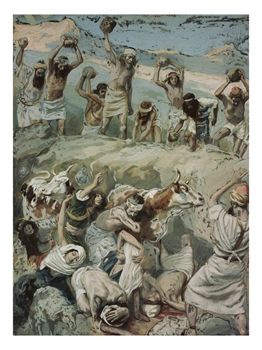
superstock_999-493_b~Achan-and-His-Family-Stoned-to-Death-Posters

Achan & family stoned to death

Tim Jennings has a very good illustration on this point (4).   A few years ago an Iraqi grocer and his family were killed and the grocery store was burned down because he had the audacity to place celery sticks next to tomatoes. What’s the problem with that, you ask? Some felt that this was highly offensive because it could be interpreted as an erect male and so he was killed.

Now, if you were appointed governor of this town and you were creating law, let’s say that you decided that drunk driving was serious and that you wanted a penalty that was sufficient to deter this behavior. Suppose that you chose a $500 fine and 5 days in jail. What would this imply to the people? If celery sticks next to tomatoes results in death, would this not suggest that drunk driving is far less serious? How do you effectively reach people when their sense of justice is entirely warped?

But, of course, the other difficult aspect of Achan’s story is that not only was Achan stoned to death, but also his wife, children…even the pets. Why? Once again, we are dealing with a culture, time, and a conception of justice that is so different from ours. In our time and society, we champion freedom and we are deeply individualistic, but this was not true in Achan’s time. During this time, one’s person and one’s personality extended to the entire family and so Achan’s sin, in the minds of the people, equally involved everyone in his family (5).  And so, once again, God condescended to work within a system of justice that we cannot identify with and that was far, far, from the ideal – and I think it made God sick.

E.    “Eye for an eye”:

Jesus didn’t deny that he gave the rule “An eye for an eye” during a chaotic and violent time, but he did forbid this practice for his followers, once again implying that this rule was given only to reach us in our heard hearted rebellion.

“You have heard that it was said, ‘An eye for an eye, and a tooth for a tooth.’ But now I tell you: do not take revenge on someone who wrongs you…You have heard that it was said, ‘Love your friends, hate your enemies.’ But now I tell you: love your enemies and pray for those who persecute you, so that you may become the children of your Father in heaven.”
(Matthew 5:38-44)

mt05_38

"You have heard it said, "An eye for an eye, and a tooth for a tooth..."

Despite these clear and cutting words of Jesus, Christians still generally practice “eye for an eye” methods in the world but yet we are commanded by Christ to “not take revenge on someone who wrongs you.” And so when one country A bombs country B because they have been wronged, call that violent response whatever you want, but do not call it a “Christian” action or associated it with the name “Christ” in any way! The words bear repeating: “Do not take revenge on someone who wrongs you…love your enemies and pray for those who persecute you.”

In Jesus we can say that Gandhi was right, “An eye for an eye makes the whole world blind.”

F.    Women:

Examples of God giving in to something that is far less than the ideal come from the New Testament as well. When Paul was dealing with the church of Corinth which was coming out of idolatrous worship, he had to use these same methods. A man was sleeping with his step-mother, people were getting drunk at the Lord’s Supper, and the worship experience was chaotic. Just down the street in Corinth was the Temple of Apollo. According to legendary accounts, there may have been as many as 1,000 temple prostitutes who “served” at any given time in this temple. In order to lead these immature Christians away from this form of false worship and everything associated with it, Paul had to say this:

“…God does not want us to be in disorder but in harmony and peace. As in all the churches of God’s people, the women should keep quiet in the meetings. They are not allowed to speak…If they want to find out about something, they should ask their husbands at home. It is a disgraceful thing for a woman to speak in a church meeting.”
(1 Corinthians 14:33-35)

Is this the ideal or is Paul meeting these people where they are?

footnotes:

(1)  Good News Tour conference 2006
(2)  Alexander Campbell, “An Address on War”, Millenial Harbinger, 1848, pg. 375
(3)  A great sermon title by Alden Thompson
(4)  Good News Tour, 2007
(5)  This is known as “corporate justice”

———————————————————————————————————————————————

Okay, lots to chew on… Even though I’m totally impatient and excited to show you the rest of the essay, I’ll post PART 2 in a few days to give you some time to read all the way through it.

Keep thinking!

Did Jesus Contradict Himself?

Hope you all had a terrific “Memorial Day”!

Welcome back to work!  I had the privilege to read several of your beautiful stories of celebrating the holiday by honoring the value of ALL people who have been killed in the human disease of violence and warfare.  What creativity some of you have shown in bringing great honor to God and his children!  Thank you for sharing those stories.  And we stand in remembrance with those of you who have lost loved ones to these conflicts.

hagia_sophia_vestibule_christ_mosaicToday, we will continue our discussion on how a follower of Jesus should respond to violence and whether or not we are ever to involve ourselves in this type of activity.  We are building on several concepts here as we go along.  Here is what we have established so far:

1)    We may disagree on this issue, but we UNITE in prayer for those engaged in war  (click here for post)

2)    Jesus is the FULL EXPRESSION of God.  (click here for post)

3)    Jesus CONSISTENTLY condemns violence of any kind  (click here for post)

In this post we will be looking at the VERY FEW passages in the life of Jesus that some have suggested give us license to use physical violence if necessary.  However, it is my contention that these passages have been interpreted this way because people approach them with pre-conceived notions that violence MUST BE acceptable at some level.  These already held convictions, then, read into these texts what the mind already wants to see.

In contrast to this type of eisegesis (reading what we hope to find INTO the biblical text rather than allowing meaning to arise OUT of it), we will be seeking to make better sense of Jesus’ words and actions by fitting them into the broader context of His easily understood and consistent commands against violence.

Here are some thoughts on several of the passages in question:

Luke 22:36-38

In this scripture, Jesus is pictured as actually commanding his disciples to obtain weapons.  What does a pacifist make of this?  Let’s read it and then make a few comments…

lk22_4935 [Jesus] asked them [the eleven apostles], “When I sent you out without a purse, bag or sandals, did you lack anything?”

They said, “No, not a thing.”

36 He said to them, “But now the one who has a purse must take it, and likewise a bag. And the one who has no sword must sell his cloak and buy one. 37 For I tell you, this scripture must be fulfilled in me: ‘And he was numbered among the lawless’; and indeed what is written about me is being fulfilled.”

38 They [the disciples] said, “See, Lord, here are two swords.”  “It is enough,” he replied. (NRSV)

1)    Jesus tells them to only buy TWO swords?  If Jesus really intends for them to use violence against a mob that is sure to approach them, would only TWO swords really be enough?  It seems as though Jesus has something else in mind rather than physical protection through violence as only two swords for twelve men is rather inadequate.

2)    Jesus directly rebukes Peter for actually using a sword just a few verses later.

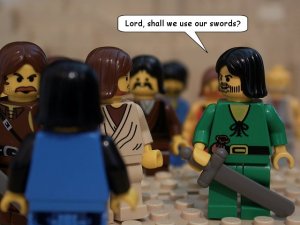
jn18_1049 When Jesus’ followers saw what was going to happen, they said, “Lord, should we strike with our swords?” 50 And one of them struck the servant of the high priest, cutting off his right ear.
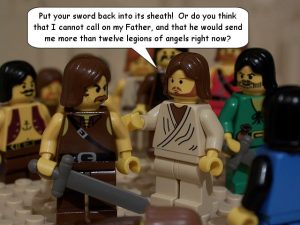
51 But Jesus answered, “No more of this!” And he touched the man’s ear and healed him.

In a similar telling of the story found in John 18:10-11, Jesus actually responds to Peter’s violence with a blatant rebuke.   Certainly Jesus wouldn’t contradict Himself this blatantly by arming his disciples for an impending battle and then just a few verses later when the conflict arises (apparently in the form of self-defense) condemning them for using the weapons!

3)    Jesus openly declares he is not leading a violent rebellion.  In the very next verse!

52 Then Jesus said to the chief priests, the officers of the temple guard, and the elders, who had come for him, “Am I leading a rebellion, that you have come with swords and clubs?

jn18_11Jesus makes it very clear to the people around him that he is in fact doing the opposite of what many today assume that he is doing in this section!

4)    Jesus is likely referring only to the fulfillment of Scripture.

37 For I tell you, this scripture must be fulfilled in me: ‘And he was numbered among the lawless’; and indeed what is written about me is being fulfilled.”
38 They [the disciples] said, “See, Lord, here are two swords.”
“It is enough,” he replied. (NRSV)

Jesus quotes Isaiah 53:12 saying that he is destined to be arrested as a criminal.  In Jesus day, criminals carried weapons, and Jesus encourages the disciples to obtain these “props” in order to fulfill this prophecy.  Much like he has them obtain a donkey for his parade into Jerusalem to fulfill that prophecy.  Thus Jesus needs only TWO swords to satisfy this need.

This section is about the fulfillment of prophecy, not an empowerment of disciples to physical violence.   To suggest otherwise, makes Jesus out to be a rather incompetent military general.  =)

Matthew 10:34

Again, the greater context of this verse is key to understanding Jesus’ statement.

32 “Whoever acknowledges me before men, I will also acknowledge him before my Father in heaven. 33 But whoever disowns me before men, I will disown him before my Father in heaven. 34 Do not suppose that I have come to bring peace to the earth, but a sword. 35 For I have come to turn
a man against his father,
a daughter against her mother,
a daughter-in-law against her mother-in-law—
36 a man’s enemies will be the members of his own household [Mic. 7:6]
37 Anyone who loves his father or mother more than me is not worthy of me; anyone who loves his son or daughter more than me is not worthy of me; and anyone who does not take up his cross and follow me is not worthy of me. 39 Whoever finds his life will lose it, and whoever loses his life for my sake will find it.”

1)    Jesus is not talking about a literal sword.   Many times Jesus speaks in a non-literal fashion to add emphasis.  For instance, he tells us to “gouge out our eye” if it causes us to sin and “cut off our hand” if it causes us to sin (Matthew 5: 29-30).   Surely he doesn’t mean for us to actually DO these things!  He is speaking in hyperbole.

lk14_262)    Jesus means that he will bring DIVISION to even our most cherished relationships.   Jesus uses strong hyperbole to stress the reality that following Jesus has a cost.  That cost includes alienating us from friends and even family when we choose to follow him and they do not.

Or apparently from other believers who are offended that we would dare to suggest that Jesus was a pacifist!  (hahahaha, take it easy, it’s a joke!)

Luke records the same words this way: (Luke 12:49-53)

49 “I have come to bring fire on the earth, and how I wish it were already kindled! 50 But I have a baptism to undergo [my death], and how distressed I am until it is completed! 51 Do you think I came to bring peace on earth? No, I tell you, but division. 52 From now on there will be five in one family divided against each other, three against two and two against three. 53 They will be divided, father against son and son against father, mother against daughter and daughter against mother, mother-in-law against daughter-in-law and daughter-in-law against mother-in-law.”

The proper way to interpret Scripture is to let verses clarify other verses, particularly parallel passages. And now Luke 12:49-53 confirms the non-literal interpretation of Matt. 10:34. Jesus did not endorse physical violence against one’s own family, but he warns people about possible family division.

Matthew 21:12-15

And finally, the one that makes the very least sense to me in the context of this whole discussion…

12 Jesus entered the temple courts and drove out all who were buying and selling there. He overturned the tables of the moneychangers and the benches of those selling doves. 13 “It is written,” he said to them, ” ‘My house will be called a house of prayer,’  but you are making it a den of robbers.'”
14 The blind and the lame came to him at the temple, and he healed them. 15 But when the chief priests and the teachers of the law saw the wonderful things he did and the children shouting in the temple courts, “Hosanna to the Son of David,” they were indignant..  (TNIV)

jn02_15bThis story is often quoted as an example of Jesus employing physical violence to achieve his goal.  And though I am of half-a-mind to not even mention it for the lack of credible support of this view, I suppose we may as well discuss it.

There is absolutely no reason to read this story with any understanding that Jesus performs physical violence on other humans.   Certainly he creates a commotion, but he is not endorsing or engaging in violence as a solution to anything.  Here are several better ways to understand this passage:

1)    Jesus as involved in civil disobedience.  Jim Consedine puts it this way,

“. . . . there is another way of looking at this episode that is more consistent with the rest of his teachings. Seen as an act of civil/religious disobedience, similar to that conducted by Te Whiti and Tohu, Mohandas Gandhi, Martin Luther King and Ploughshares activists centuries later, it makes much more sense . . . . . . All of these people acted from religious outrage and disrupted civil processes, similar to the way Jesus acted. All are recognized internationally as leaders of non-violent direct action and role models of non-violent living.  So should Jesus be.”

Jesus neither harms people nor animals, but is creating a form of active protest toward the religious leaders.  This will be a great point of reference as well look into a future post on how Christians can be ACTIVE and not passive as we embrace a lifestyle of non-violence.

mk11_15b2)    Jesus as a Preacher.  Just as Hosea marries a prostitute to make a strong preaching illustration, Jesus overturns tables to show his disdain for the sham that the religious leaders have made of worship for God.   It is tantamount to a dramatic sermon illustration.  In the pattern of the prophets, he condemns the religious authorities.  In fact, this is a method of preaching that would have been understood and commonplace for His Jewish culture.

3)    The Jewish leaders are apparently not offended by any “violence” done against the moneychangers, but toward Jesus’ upsetting of their structures and His ministry to the blind, lame, and children.

Jesus has overturned the position of their tables and welcomed the less honorable (by their standards).   His act of civil disobedience is aimed at flipping the status quo.  Had he injured the moneychangers they would have had reason to arrest him, and yet instead despite their anger with him, they are unable to do so and he leaves unhindered.  In light of the religious leaders looking for any reason to arrest Him, the fact that Jesus leaves the scene “un-chained” is a strong indication that he does not “harm” anyone.

Now, if you are still hanging in there through this long post (certainly our longest of the series), then I commend you.   There are certainly many ways of understanding each of these stories that fit with the context of Jesus many other words of non-violence.

We’ll pick up next time on how the early church fathers and the Christians immediately following Christ interpreted and understood him on these issues.

Keep thinking!

(thank you to “The Brick Testament” for the great pictures!)

God’s Character in Reverse

Welcome.  We are in a little discussion series on whether or not Christians should be involved in violence for any reason.  I’m assuming that most Christians believe that unprovoked violence is wrong, so we will be spending most our time thinking about national violence (military), self-defensive violence (fighting or killing only when your own life is in jeopardy), and protective violence (done to protect another person).

It is a discussion that, apparently, is controversial for many people, especially Christians.

pacifism1Which, I admit, is kind of strange to me.  I obviously expect that many Christians are pro-national violence (at least as it relates to their own country), however it somewhat surprises me that these people are so vehemently opposed to the suggestion that Christ calls us to a life of non-violence.  I understand the general disagreement.  But, were I just to read the Gospels (the story of Jesus), I would assume the controversial issue would be that any Christian might actually think that violence of any kind was okay.

All that to say, from everything we know about Jesus, it seems weird to me that the non-violent position is in the minority, at least in Western Christianity.  But, I suppose that is why we are having this discussion in the first place.  And as Memorial Day approaches, it is a good time for us to think through these issues more fully.

Now there are many Scriptures that are debated and scrutinized in this dialogue, and we will be looking at these texts over the next several days.  Many of these surround God’s involvement in the nation of Israel’s military violence in the Old Testament.   Also, there are many philosophical challenges to Jesus’ way of non-violence that are often mentioned and we will deal with those as well.

However, I’d like to have us start by laying a foundation for all of this discussion somewhere else, before we dig into the rest of the arguments.  So, put aside all of this anxiously awaited fodder and lets begin somewhere more broadly.

In this post, then, I’d like us to look at where we gather our primary pictures and assumptions of God’s character.  In other words, what is our main source for knowing what God is actually like?

Youth pastors, preachers, and well-meaning leaders have told me since I was very little that I get to know who God is best through the Bible.  And while I have found this to be quite true, I have also found that it was not quite specific enough.  Through the Bible, God gives his very specific direction on how to know who He is and what He is like.

Let’s take a look at this direction:

reading-bible-blueIn Christ all the fullness of the Deity lives in bodily form”  (Colossians 2:9-10)

Jesus answered: “Don’t you know me, Philip, even after I have been among you such a long time? Anyone who has seen me has seen the Father. How can you say, ‘Show us the Father’?  (John 14:9)

He is the image of the invisible God, the firstborn over all creation.” (Colossians 1:15)

“No one has ever seen God, but God the One and Only (Jesus), who is at the Father’s side, has made him known. (John 1:18)

In other words, God says, “you want to know who I am and what I am like?  Okay, here I am.  I am exactly like this.  Like Jesus.”   He even goes so far as to say that Jesus has made God known, as if until Jesus we didn’t fully know who God was.  Apparently, as good as the stories in the Old Testament are, they didn’t reveal God adequately.

Only the Incarnate Son is an appropriate full-picture of God.

The writer of Hebrews (whoever she was) put it most directly like this:

1In the past God spoke to our forefathers through the prophets at many times and in various ways, 2but in these last days he has spoken to us by his Son, whom he appointed heir of all things, and through whom he made the universe. 3The Son is the radiance of God’s glory and the exact representation of his being, sustaining all things by his powerful word. After he had provided purification for sins, he sat down at the right hand of the Majesty in heaven.  (Hebrews 1:1-3)

Did you catch that?  (I hope so; I underlined it and made it bold).  Jesus is the EXACT REPRESENTATION of God’s being.  Nothing defines God like Jesus.  He is not an approximate picture of God, or just one side or facet of God.  He is not the non-violent side of an otherwise “just war” God.  He is the EXACT REPRESENTATION.

hagia_sophia_vestibule_christ_mosaicNow, because Jesus is the fullest picture of God, when it comes to the Bible, I am compelled to read everything through the eyes of Jesus.   As this applies to our discussion at hand, it means that I must fit any violent stories of the Old Testament (which are problematic) into what I know of Jesus as revealed in the New Testament, not the other way around.

For instance, many people read stories in the Old Testament and glean what they perceive are “attributes” or “characteristics” of God from these stories and then apply them to their picture of Jesus.   In this case, since God involves himself in the violent battles of the Israelites, then we assume that this “necessary violence” is something Jesus would condone (even if it apparently includes mass infanticide and genocide).

However, when God directs us to know Him through Jesus most perfectly, we are called to learn His character backwards.  We learn what God is like by observing and studying Jesus and then read backward through the Old Testament through His lens.

Whatever these violent stories may mean (some are more confusing than others), through the primacy of Christ we regard them as an incomplete and inadequate picture.  Where they contradict what we see in Jesus (war, genocide, even self-defensive violence), we embrace Jesus’ way as the EXACT REPRESENTATION of God, and find some other way to make sense of them.

Interestingly, I believe this is why Jesus’ time on this earth was so long.   Certainly the death of Jesus was important in freeing us from the bondage of our brokenness, but his life was equally as important.  For in his life, and ultimately in his self-sacrificial manner of death (the final exclamation point to how we should respond to violence), God demonstrates his character and what he desires.  He lives and interacts with people and finally dies non-violent in the face of violence to show THE EXACT REPRESENTATION of God.

The problem of violence in the Old Testament is admittedly uncomfortable, but however these scenes are explained, as followers of Christ we are compelled to not use them to create pictures of God that are contradictory to what we plainly see in Jesus.

Ok.  That’s enough for today.  We’ll jump into some more tangible parts of the discussion in the next post.

Happy Thinking…