McLaren Q2: The Authority of the Bible

How many Owner’s Manuals have you actually read all the way through?

Yea, me either.  In fact, I’ve got a whole drawer full of owner’s manuals that we keep in case we need them.  If it was up to me, I would have thrown most of them away long ago.  But, my wife is much smarter and more thorough than I am and keeps them filed in case the dishwasher ever breaks down and we need the document that tells us how to fix it. (Not that I could do it anyway).

So, they sit in a file.  They don’t help me with my day-to-day life.  Most days I forget they are even there.  They are just kind of an emergency reference I can pull fix-it info from if things don’t go as planned with appliances I take for granted.

In a similar way, I often treat my Bible that way too.  As a teenager, many well-meaning people told me that my Bible was like the Owner’s Manual of my life.  It told me what to do, what not to do and how to fix what was wrong.  And while there is certainly some direction in these areas, I have discovered in reading the book that its description as a Manual is quite poor.  The collection of material in Scripture is much more complex than this.

What’s more, this view of the Bible has lead to me treating it like a Manual. Most often, I’ve left it filed in the drawer, inapplicable to my daily life, ready to pull out and scan for a nugget of “fix-it” advice when necessary.  Too easily the manual is left unread or if finally read, read poorly, too simplistically and ripped out its natural context and applied incorrectly.

In this second interview with www.theooze.tv, Brian McLaren speaks briefly about how we might re-frame our view of Scripture.  Instead of the metaphor of a Manual, he employs the picture of a legal-document (or constitution), which is another common well-meaning but misguided view of the Bible.

Just another addition to his new book, “A New Kind of Christianity.” A good source of enough thought-provoking material to open a dialogue.  Watch the video and leave a comment to join the conversation.

McLaren Q1: The Narrative Question

Looking for a good, open conversation about faith?

Well, our friends at the conversation-starting website: www.theooze.tv are currently doing a video series with Brian McLaren about his new book: “A New Kind of Christianity: Ten Questions that are Transforming the Faith”.

Each video features McLaren discussing one of the specific questions raised in his book.  And, due to the subject matter, I’m sure there will be much conversation generated! And really that is the goal.  There may be more than one thing that you find yourself at odds with him about, but according to McLaren himself, these questions:

“are not intended as a smash in tennis, delivered forcefully with a lot of topspin, in an effort to win the game and create a loser. Rather, they are offered as a gentle serve or lob; their primary goal is to start the interplay, to get things rolling, to invite your reply. Remember, our goal is not debate and division yielding hate or a new state, but rather questioning that leads to conversation and friendship on the new quest.”
(Brian McLaren)

So, here is the first of these videos.  It discusses briefly, McLaren’s first few chapters on the “storyline” of the Bible and how to properly frame our picture of Jesus.  Give it a quick view (less than 5 minutes) and feel free to comment here on your thoughts or go to www.theooze.tv and watch them all as they become available.

A New Kind of Christianity

Books have been boring lately. Well, maybe it’s not the books. But, it just seems like nothing has piqued my interest too much in things I’ve been reading. Until recently…

Author, Brian McLaren

I picked up Brian McLaren’s new book, “A New Kind of Christianity” last week.

And while I usually enjoy reading his books, I found that this new book has put excellent words to thoughts I have been thinking and even blogging about here for quite a while.

I’m still processing some of his thoughts, but i was especially drawn to McLaren’s focus on the supremacy and centrality of Christ in our understanding of God. This is something that I have argued for many times, especially in our discussion of non-violence.

(to read my related post–“God’s Character in Reverse”– click here)

Here is how McLaren explains it:

“The Quaker scholar Elton Trueblood approached the Bible this way. One of Trueblood’s students told me that he often heard his mentor say something like this: “The historic Christian doctrine of the divinity of Christ does not simply mean that Jesus is like God. It is far more radical than that. It means that God is like Jesus.”

"A New Kind of Christian" by Brian McLaren

In other words, the doctrines of the incarnation and deity of Christ are meant to tell us that we cannot start with a pre-determined, set-in-stone idea of God derived from the rest of the Bible, and then extend that to Jesus. Jesus is not intended merely to fit into those pre-determined categories; he is intended instead to explode them, transform them, alter them forever and bring us to a new evolutionary level in our understanding of God. An old definition of God does not define Jesus: the experience of God in Jesus requires a new brand definition or understanding of God.

Trueblood’s insight, in my opinion, is the best single reason to be identified as a believer in Jesus, and it is an unspeakably precious gift that can be offered to people of all faiths. The character of Jesus, we proclaim, provides humanity with a unique and indispensable guide for tracing the development of maturing images and concepts of God across human history and culture. It is the North Star, if you will, to aid all people, whatever their religious background, in their theological pilgrimage. The images of God that most resemble Jesus – whether they originate in the Bible or elsewhere – are the more mature and complete images, and the ones less similar to the character of Jesus would be the more embryonic and incomplete – even though they may be celebrated for being better than the less complete images they replaced.

This is why we cannot simply say that the highest revelation of God is given through the Bible (especially the Bible read as a constitution, or cut and pasted to fit in the Greco-Roman six-line narrative). Rather, we can say that, for Christians, the Bible’s highest value is in revealing Jesus, who gives us the highest, deepest, and most mature view of the character of the living God.”

A New Kind of Christianity, pages 114-115

Very well said. And I don’t think I can over-estimate the importance of this placing of Jesus as the central focus of the question: “what God is actually like.” It is maybe the most singularly critical aspect of our faith that I think we need restored today.

This is a very, very crucial discussion that has implications for all aspects of the Christian life. And, I’m glad to see other people chiming in on this most important component of how we see and understand God. I would highly encourage you to pick up this book today and give it a read. You may not agree with everything, but it will certainly challenge you to stretch your conception of God.

Happy thinking.

My Church and Non-Violence

What does my specific church history teach about non-violence?

As we pick up our discussion on “Jesus & Non-violence” again today I am going to say very little and allow several historical voices to share their understanding of obedience to Christ and renunciation of violence.

A little background will be helpful.

I belong to an independent and non-denominational Christian church.  I wrote about the roots and history of this movement in my last post (Restoring the Conversation).

And I have spent the last few weeks researching the position my church has historically taken on violence and war.  In this research, I discovered that nearly all of the founding visionaries of this movement were well known pacifists.

These leaders include Alexander Campbell, Barton W. Stone, Benjamin Franklin, J.W. McGarvey, Moses E. Lard, Robert Milligan, Tolbert Fanning, David Lipscomb and many, many others.

Apparently, the apple does not fall far from the tree!

By far the two most notable people in this list are Alexander Campbell and Barton Stone.  Campbell specifically has an amazing essay on the issue titled, “An Address on War.”  I wish I could print the entire thing here.   I may work on getting it online at some point.   But, lets just take a quick look at the statements of these two influential men, without whom my church would not exist today.

——————————————————————————————————————–

Alexander Campbell

Alexander Campbell

“But as respects the works peculiar to a soldier, or the prosecution of a political war, they (have) no commandment.  On the contrary, they were to live peaceably with all men to the full extent of their power.  Their sovereign Lord, the King of nations, is called ‘The PRINCE OF PEACE.’  How, then, could a Christian soldier, whose ‘shield’ was faith, whose ‘helmet’ the hope of salvation, whose ‘breastplate’ was righteousness, whose ‘girdle’ was truth, whose ‘feet were shod with the preparation of the gospel of peace’ and whose ‘sword’ was that fabricated by the Holy Spirit, even ‘the Word of God.’  I say, how could such a one enlist to fight in the battle of a Cesar, a Hannibal, a Tamerlane, a Napoleaon, or even a Victoria?-!”

— Alexander Campbell (“An Address on War.”  Millennial Harbinger, 1848.  Pg. 374)

“Two swords for twelve Apostles?  Truly they are dull scholars who thence infer he meant that they should literally buy two swords to fight with!”
— Alexander Campbell (“An Address on War.”  Millennial Harbinger, 1848.  Pg. 375)

“Decidedly, then, the spirit of Christianity is essentially pacific.”
— Alexander Campbell (“An Address on War.”  Millennial Harbinger, 1848.  Pg. 375)

“That the genius and spirit of Christianity, as well as the letter of it, are admitted, on all hands, to be decidedly ‘peace on earth and good will among men,’ needs no proof to any one that has ever read the volume that contains it.”
–Alexander Campbell (“An Address on War.”  Millennial Harbinger, 1848.  Pg. 375)

tfanning

Tolbert Fanning

“Need we any other proof that a Christian people can, in no way whatever, countenance a war as a proper means of redressing wrongs, of deciding justice, or of settling controversies among nations?”
–Alexander Campbell (“An Address on War.”  Millennial Harbinger, 1848.  Pg. 377)

“The precepts of Christianity positively inhibit war—by showing that ‘wars and fighting come from men’s lusts and evil passions’, and by commanding Christians to follow ‘peace on earth and good will among men.’”
–Alexander Campbell (“An Address on War.”  Millennial Harbinger, 1848.  Pg. 383)

“We must create a public opinion on this subject.  We should inspire a pacific spirit, and show off on all proper occasions the chief objections to war.
–Alexander Campbell (“An Address on War.”  Millennial Harbinger, 1848.  Pg. 385)

“In the language of the eloquent Grimke, we must show that ‘the great objection to war is not so much the number of lives and the amount of property it destroys, as its moral influence on nations and individuals.  It creates and perpetuates national jealousy, fear, hatred, and envy.  It arrogates to itself the prerogative of the Creator alone, to involve the innocent multitude in the punishment of the guilty few.  It corrupts the moral taste, and hardens the heart; cherishes and strengthens the base and violent passions, destroys the distinguishing features of Christian charity, its universality and its love of enemies’; turns into mockery and contempt the best virtue of Christians—humility;  weakens the sense of moral obligation;  banishes the spirit of improvement, usefulness, and benevolence, and inculcates the horrible maxim that murder and robbery are matters of state expediency.’”
–Alexander Campbell (“An Address on War.”  Millennial Harbinger, 1848.  Pg. 385)

“The spirit of war is always a rebellious spirit.”
–Alexander Campbell (“The Spirit of War.”  Millennial Harbinger, 1861.  Pg. 338)

“The Christian is not permitted to redress his wrongs by taking vengeance upon the wrong-doer.  He is to commit his cause to Him who judges righteously, to whom vengeance belongs.”
–Alexander Campbell (“The Spirit of War.”  Millennial Harbinger, 1861.  Pg. 338)

“Now we trust that no Christian man who fears God and desires to be loyal to Messiah, the Prince of Peace, shall be found in the ranks of so unholy a warfare.”
–Alexander Campbell (“The Spirit of War.”  Millennial Harbinger, 1861.  Pg. 339)

David Lipscomb

David Lipscomb

“I freely expressed my views of war and other aberrations from the Christian religion.”
–Alexander Campbell (“War.”  Millennial Harbinger, 1846.  Pg. 638)

“But so long as any man admits the dying testimony of Jesus Christ to be true, he must, I contend, give up his ‘Christian wars’ ‘Christian armies,’  ‘Christian navies,’ ‘Christian victories,’ and military glory.
–Alexander Campbell (“War.”  Millennial Harbinger, 1846.  Pg. 640)

(speaking of Jesus’ claim that His kingdom is not of this world) “The conclusion of these words is inevitable.  My kingdom being not of this world, my servants cannot fight for me, not even in a defensive war.”
–Alexander Campbell (“War.”  Millennial Harbinger, 1846.  Pg. 640)

“If, then, the Messiah would not, in defense of his own life, have his servants to take the sword, for whose life ought it to be unsheathed?!”
–Alexander Campbell (“War.”  Millennial Harbinger, 1846.  Pg. 641)

“Indeed, the spirit of war and the spirit of Christ are as antipodal as light and darkness, as good and evil.”
— Alexander Campbell (“War.”  Millennial Harbinger, 1846.  Pg. 641)

“Christianity, (is) essentially pacific, conciliatory, and forgiving.  The Saviour of the world is the Prince of Peace, and all his true subjects are sons of peace and advocates of glory to God in the highest, peace on earth, and good will amongst men.”
–Alexander Campbell (“War and Christianity Antipodal.”  Millennial Harbinger, 1850.  Pg. 524)

Barton W. Stone

Barton W. Stone

“His laws are pacific, he is the Prince of Peace—his subjects are the children of peace.  Nothing appears so repugnant to the kingdom of heaven as war…”
–Barton W. Stone  (“Christians Holding Offices.”   The Christian Messenger, 1842.  Pg. 205)

(speaking of Christians and war), “If these things be true, the Christian world is truly in an awful state of apostacy!  It is surely high time to think seriously and reform.”
–Barton W. Stone  (“Christians Holding Offices.”   The Christian Messenger, 1842.  Pg. 205)

“The Gospel aims a death blow at the very root and principle of war”
— Barton W. Stone  (The Christian Messenger, July 1835)

—————————————————————————————————————–

Wow, quite a body of work from just TWO of the leaders of this movement.  Much more could be quoted from David Lipscomb (a Christian anarchist) and Tolbert Fanning alone.  For purposes of space, however, I thought that these two provided an adequate representation of the many others.

Maybe most interesting are Alexander Campbell’s words at the end of his “Address on War.”  Not only does he lay out a great case for pacifism, he ends by pleading for all of us to promote the cause of the non-violent kingdom of God whenever possible…

“I must confess that I both wonder at myself and am ashamed to think that I have not spoken out my views, nor ever before written an essay  on this subject . . . I am sorry to think, very sorry indeed, to be only of the opinion, that probably even this much published by me some three years, or even two years ago, might have saved some lives that have been thrown away in the desert—some hot-brained youths.

“We must create a public opinion on this subject.  We should inspire a pacific spirit, and show off on all proper occasions the chief objections to war.
–Alexander Campbell (“An Address on War.”  Millennial Harbinger, 1848.  Pg. 385)

I presume Campbell would be pleased with this topic for our conversation.

Okay, next post we will have a guest blogger!  Very exciting!

Keep thinking and growing!

Book Review – “EXILES”

Taking a little break from our non-violence series again today, I thought I would share another book with you that I recently finished.   I know that many of you have asked for some resources and helpful books to read regarding what we call “church” and hopefully the books I mention here will be of value to you.

exilesToday’s book is called, “Exiles” by Michael Frost.

This book is definitely one of the best books that I have read all year.  (Okay, so we’re only 6 months through the year, but I do read a lot).

The word, “Missional” is maybe the hottest church-fad word around these days.  In fact, I hear it all the time in staff meetings and among peers.

“What are we doing to be more missional?”

I hear church leaders asking this question all the time, but sometimes I wonder, “Do we even know what that means?”

The danger of “Missional” becoming the pop-church word is that it becomes absorbed into the programmatic paradigm of Western consumer-church.   “Missional” becomes just another in a long line of “cool” programs to get people into our buildings.  But mission is so much more!

If you really want to understand the concept of a “Missional Church” then this is required reading for Class 101.   “Exiles” is the missional handbook for a new generation of Jesus-followers trying to feel their way through a world that is broken and a church that feels irrelevant.

In his own words, the author says his book is written for:

“…those Christians who find themselves falling into the cracks between contemporary secular Western culture and a quaint, old-fashioned church culture of respectability and conservatism.

Michael Frost

Michael Frost

This book is for the many people who wish to be faithful followers of the radical Jesus but no longer find themselves able to fit into the bland, limp, unsavory straitjacket of a church that seems to be yearning to return to the days when ‘everyone’ used to attend church and ‘Christian family values’ reigned.

This book is for those who can’t remain in the safe modes of church and who wish to live expansive, confident Christian lives in this world without having to abandon themselves to the values of contemporary society.  This book is for those Christians who feel themselves ready (or yearning) to jump ship but don’t want to be left adrift in a world where greed, consumerism, laziness, and materialism toss them about endlessly and pointlessly.  Such Christians live with the nagging tension of being at home neither in the world nor in the church as they’ve known it.”

If any of those words describe you or what you have felt in regards to church and life, then I would visit Amazon.com immediately and order this book.

This book is broken down into four sections that deal with the “danger” of being a self-imposed exile in this world.   According to Frost, our primary citizenship and allegiance to the kingdom of God makes us EXILES to the power structures of this world.   Thus, these “self-imposed EXILES” continue their hope and heritage by clinging to their Dangerous Memories, Promises, Criticism and Songs.  Each section has its own unique points of interest and exploration.

Among his best insights is the idea that in trying to create churches with “deep community” we have pursued the wrong goal.   Of course community is good, but community for the sake of community, Frost argues, will ultimately fail.   Real community is formed by a group of people “exiling” themselves from the way of the world and serving in the trenches of mission together.

For Frost, a common mission forges the deepest community.  Authentic and meaningful community is essential, but it is the by-product of our involvement in a mission together.   Mission is the goal; community is what happens during the journey.

page30_4If the future of church is even remotely interesting to you, I cannot recommend this book more highly.   Michael Frost writes with a very direct and honest voice that will bring enlightenment to the casual reader as well as enough research and detail to enthrall the more intense studier.    

This book is a MUST READ!

If I could, I’d hold every American Christian’s eye-lids open to make sure they finished it.  🙂

My Rating:  4.5 out of 5 stars

Bring Your Gun to Church Day!

We’ll continue with our discussion on “Jesus and Non-violence” in the next post, but a friend of mine mentioned this news story to me yesterday.  It was so appalling that I couldn’t help but share it with you.  I wanted to laugh (oh, Kentucky, you make me wanna laugh all the time), cry, and pull my eye balls out in frustration all at the same time.

If this isn’t the perfect example of the church confusing and blending the kingdom of God with the kingdoms of this world than I don’t know what is.

Please understand, at issue is not whether people should carry and use guns (a whole other discussion), but of what business this is for the church.  Why is the church’s message and mission being watered down to make political statements about bearing arms?

Just ask yourself this as you watch:

“Is it the church’s job to protect my American rights?”

“Did Jesus die for our right to bear arms?”

“Is protecting the 2nd amendment even close to part of the mission of the church?”

“We’re just going to celebrate the upcoming theme of the birth of our nation,” said pastor Ken Pagano. “And we’re not ashamed to say that there was a strong belief in God and firearms — without that this country wouldn’t be here.”

Wow, that quote alone is enough to make you wonder whether this guy worships America or God.  It seems that for him, the church exists to secure his American way of life.  Very close, if not completely overtly, a form of idolatry.

Think about it.

John 18:36
Jesus answered, “My Kingdom is not an earthly kingdom. If it were, my followers would fight to keep me from being handed over to the Jewish leaders. But my Kingdom is not of this world.

Telephone Game & the First Christians

Remember playing the “telephone game” when you were little?   You know, someone comes up with a statement and whispers it in the ear of the person next to them, who then repeats what they heard to the next person down the line, and so on and so on.

Girlfriends+Border_Girls+whispering4And if you remember playing this game, then you remember how funny it was when the last person to get the message finally tells everyone else what strange sentence they heard at the end of the line.  Most of the time, the statement began as something like, “The baker made an apple pie” and ended up as “Your face makes me wanna cry.”   They rhyme, but they aren’t really the same thing.

And even as a 7-year-old, I learned something simple.  It’s best to get information right from the source, because over time and even through good intentions (except for that one kid in my class who was always trying to purposely screw up the telephone message), the information evolves into something possibly different than what was intended.

We are involved right now in a discussion about violence and whether or not Christians should ever engage in it, even to protect their own life.   And I know that many Christians today have some strong opinions on this 2ymvo2hmatter, but I would like to caution us to rethink our stance in light of the telephone game.

You see, I come from a church tradition that while honoring and learning from the history of church through the centuries, looks to the early church and The SOURCE (Jesus) as its primary ideal and guide.

As we approach this topic, however, we may have done a rather poor job of maintaining this approach.

I would like to suggest that many of the currently popular rationalizations of a “just war” or engagement in any sort of violence is due in large part to a long running game of church telephone, in which we’ve diverted a bit from the original SOURCE.  So far are we from the source, in fact, that we consider The SOURCE to be too radical and our modern, westernized ways to be more progressive and advanced.  Surely we must use violence sometimes?  Our cause is just!  How can we achieve the greatest peace for the most people if not by using violence to defeat the foes?

The message still sounds understandable and we can rationalize it, but maybe it isn’t at all what The SOURCE intended or what those who heard the message first understood.

Somewhere along the way, Jesus’ message of a different type of kingdom that did not rely on the power methods of this world has evolved all the way into our current and prevalent situation of syncretism between church and state (or national pride).

So, as we journey back to “the origins” we have already seen how The SOURCE (Jesus) consistently and regularly commanded us to forsake violence and how His life was the greatest testimony to a power absent of coercion and violence. (see previous post here)

Today, we will look at how the first 300 years of people in the telephone line behind him understood His message.  And although 300 years sounds like a long time, it is but a brief beginning in a movement that has stretch into its 3rd millennium.

Here is how violence was understood for the first followers of this Christ.

The Witness of the FIRST CHRISTIANS:

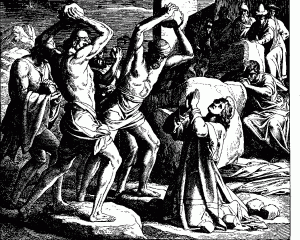
The Early Church position ruled out violence as an option, even in self-defense.  The evidence for this is overwhelming and includes the story of Stephen found in Acts 7:59-60.  In the story Stephen is stoned to death for his faith, but even at the moment before death, he forgives his assailants for their crime.
228A similar story is found later in the book of Acts when Paul is also violently attacked for his beliefs, and yet does not seek revenge:

The crowd stoned Paul and dragged him outside the city, thinking he was dead. But after the disciples had gathered around him, he got up and went back into the city. Then they returned to Lystra, Iconium and Antioch, strengthening the disciples and encouraging them to remain true to the faith. “We must go through many hardships to enter the kingdom of God,” they said.
(Acts 14:19-22 NIV)

In Paul’s first letter to the Corinthian Church, he writes of the importance of non-retaliation, even in the face of death:

It seems to me that God has put us on display at the end of the procession, like those condemned to die in the arena. We have been made a spectacle to the whole universe. To this very hour we go hungry and thirsty, we are in rags, we are brutally treated, we are homeless. Yet when we are cursed, we bless; when we are persecuted, we endure it; when we are slandered, we answer kindly.
(1 Corinthians 4:9-13 NIV
)

Beyond what we find in the New Testament, there is great consensus among the people that immediately followed in the next several hundred years.  As demonstrated by the following quotes, no Early Church father interpreted Jesus’ teachings as advocating anything but strict nonviolence:

—————————————————————————————————

The Lord, in disarming Peter, disarmed every soldier.
—Tertullian’s On Idolatry

origen

Origen

“Christians could never slay their enemies. For the more that kings, rulers, and peoples have persecuted them everywhere, the more Christians have increased in number and grown in strength.”
—Origen Contra Celsius Book VII

“Wherever arms have glittered, they must be banished and exterminated from thence.”
—Lactantius’ Divine Institutes IV

“As simple and quiet sisters, peace and love require no arms. For it is not in war, but in peace, that we are trained.”
—Clement of Alexandria Chapter 12 of Book 1

“In their wars, therefore, the Etruscans use the trumpet, the Arcadians the pipe, the Sicilians the pectides, the Cretans the lyre, the Lacedaemonians the flute, the Thracians the horn, the Egyptians the drum, and the Arabians the cymbal. The one instrument of peace, the Word alone by which we honor God, is what we employ.”
—Clement of Alexandria Chapter 4 of Book 2

“Above all, Christians are not allowed to correct with violence.”
—Clement of Alexandria

hippolytus

Hippolytus of Rome

“I do not wish to be a king; I am not anxious to be rich; I decline military command… Die to the world, repudiating the madness that is in it.”
—Tatian’s Address to the Greeks 11

“We who formerly used to murder one another now refrain from even making war upon our enemies.”
—The First Apology of Justin Martyr 39

“Whatever Christians would not wish others to do to them, they do not to others. And they comfort their oppressors and make them their friends; they do good to their enemies…. Through love towards their oppressors, they persuade them to become Christians.”
—The Apology of Aristides 15

“A soldier of the civil authority must be taught not to kill men and to refuse to do so if he is commanded, and to refuse to take an oath. If he is unwilling to comply, he must be rejected for baptism. A military commander or civic magistrate must resign or be rejected. If a believer seeks to become a soldier, he must be rejected, for he has despised God.”
—Hippolytus of Rome

“There is nothing better than peace, in which all warfare of things in heaven and things on earth is abolished.”
—Ignatius of Antioch to the Ephesians 13

saint_Irenaeus_Early_Church_Father

Irenaeus

“The new covenant that brings back peace and the law that gives life have gone forth over the whole earth, as the prophets said: “For out of Zion will go forth the law, and the word of the Lord from Jerusalem; and he will instruct many people; and they will break down their swords into plowshares, and their spears into pruning hooks, and they will no longer learn to make war.” These people formed their swords and war lances into plowshares,” that is, into instruments used for peaceful purposes. So now, they are unaccustomed to fighting, so when they are struck, they offer also the other cheek.”
—Irenaeus

“We would rather shed our own blood than stain our hands and our conscience with that of another. As a result, an ungrateful world is now enjoying–and for a long period has enjoyed–a benefit from Christ. For by his means, the rage of savage ferocity has been softened and has begun to withhold hostile hands from the blood of a fellow creature. In fact, if all men without exception…would lend an ear for a while to his salutary and peaceful rules,…the whole world would be living in the most peaceful tranquility. The world would have turned the use of steel into more peaceful uses and would unite together in blessed harmony.”
—Arnobius

“Wars are scattered all over the earth with the bloody horror of camps. The whole world is wet with mutual blood. And murder–which is admitted to be a crime in the case of an individual–is called a virtue when it is committed wholesale. Impunity is claimed for the wicked deeds, not because they are guiltless, but because the cruelty is perpetrated on a grand scale!”
—Cyprian of Carthage

“Those soldiers were filled with wonder and admiration at the grandeur of the man’s piety and generosity and were struck with amazement. They felt the force of this example of pity. As a result, many of them were added to the faith of our Lord Jesus Christ and threw off the belt of military service.”
—Disputation of Archelaus and Manes

“We have rejected such spectacles as the Coliseum. How then, when we do not even look on killing lest we should contract guilt and pollution, can we put people to death?”
—Athenagoras of Athens’ A Plea for the Christians 35

———————————————————————————————-

Strong statements, huh?  Apparently the first Christians were pretty clear on what they heard from the life and words of Jesus regarding this topic.

Consider that for three entire centuries after Jesus’ death and resurrection, almost completely universally, Christians believed that even self-defense violence was inappropriate for followers of Christ.

So what changed?

Most notably, the Roman Emporer, Constantine.
constantinevision

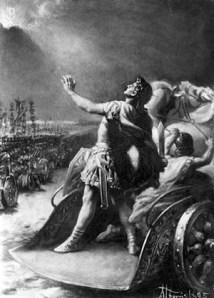
Constantine's Battle of Milvian Bridge in 312 AD

Christian sources record that Constantine experienced a dramatic event in 312 at the Battle of Milvian Bridge, after which Constantine would claim the emperorship in the West. According to these sources, Constantine looked up to the sun before the battle and saw a cross of light above it, and with it the Greek words “Εν Τουτω Νικα” (“by this, conquer!”), Constantine commanded his troops to adorn their shields with a Christian symbol (the Chi-Ro), and thereafter they were victorious.

From this moment on, Christianity becomes the dominant religion of the Roman empire.   And whatever his motives (genuine spiritual conversion or political genius), Constantine changes the landscape of Christianity.  It is no longer a persecuted minority, but a powerful, state-supported, military-leading civic religion.

You can nearly draw a line in history with this event as the place the telephone message changed.

Violence was absent from the lives of the earliest followers of Christ and only by the military subversion of Christianity by the emperor, Constantine, did violence (for national purposes or any other) enter into Christianity.  The church following this event was culturally conditioned to accept the merger of empire and “Christianity” and found ways to rationalize this “new power” that soon became the “norm” at the expense of its previously radical stance on violence.  And it became a marked departure from what Christ and the original followers had taught and modeled.

Now, certainly God is mightier than a game of telephone and His message has been preserved in His church.  But, I suggest that rather significant components of this message are now held in minority in Western Christianity.

Anyway, lots more to think about.  I know for some of you this is a difficult thing to wrestle with.  It calls into a question a lot of your life and assumptions.  My heart goes out to those of you who have served or are currently serving in the military.  My goal is not to make you feel less “Christian”.   You are loved by God and by me regardless of where you come out on this issue.

However, the church must always be thinking and examining our message.  Where there have been compromises to our culture, we must return to THE SOURCE and reform.

So, though it is uncomfortable, keep thinking.   And I’ll be praying for you…

(for the complete series on “Jesus & Non-violence” see the right sidebar of this blog)

Did Jesus Contradict Himself?

Hope you all had a terrific “Memorial Day”!

Welcome back to work!  I had the privilege to read several of your beautiful stories of celebrating the holiday by honoring the value of ALL people who have been killed in the human disease of violence and warfare.  What creativity some of you have shown in bringing great honor to God and his children!  Thank you for sharing those stories.  And we stand in remembrance with those of you who have lost loved ones to these conflicts.

hagia_sophia_vestibule_christ_mosaicToday, we will continue our discussion on how a follower of Jesus should respond to violence and whether or not we are ever to involve ourselves in this type of activity.  We are building on several concepts here as we go along.  Here is what we have established so far:

1)    We may disagree on this issue, but we UNITE in prayer for those engaged in war  (click here for post)

2)    Jesus is the FULL EXPRESSION of God.  (click here for post)

3)    Jesus CONSISTENTLY condemns violence of any kind  (click here for post)

In this post we will be looking at the VERY FEW passages in the life of Jesus that some have suggested give us license to use physical violence if necessary.  However, it is my contention that these passages have been interpreted this way because people approach them with pre-conceived notions that violence MUST BE acceptable at some level.  These already held convictions, then, read into these texts what the mind already wants to see.

In contrast to this type of eisegesis (reading what we hope to find INTO the biblical text rather than allowing meaning to arise OUT of it), we will be seeking to make better sense of Jesus’ words and actions by fitting them into the broader context of His easily understood and consistent commands against violence.

Here are some thoughts on several of the passages in question:

Luke 22:36-38

In this scripture, Jesus is pictured as actually commanding his disciples to obtain weapons.  What does a pacifist make of this?  Let’s read it and then make a few comments…

lk22_4935 [Jesus] asked them [the eleven apostles], “When I sent you out without a purse, bag or sandals, did you lack anything?”

They said, “No, not a thing.”

36 He said to them, “But now the one who has a purse must take it, and likewise a bag. And the one who has no sword must sell his cloak and buy one. 37 For I tell you, this scripture must be fulfilled in me: ‘And he was numbered among the lawless’; and indeed what is written about me is being fulfilled.”

38 They [the disciples] said, “See, Lord, here are two swords.”  “It is enough,” he replied. (NRSV)

1)    Jesus tells them to only buy TWO swords?  If Jesus really intends for them to use violence against a mob that is sure to approach them, would only TWO swords really be enough?  It seems as though Jesus has something else in mind rather than physical protection through violence as only two swords for twelve men is rather inadequate.

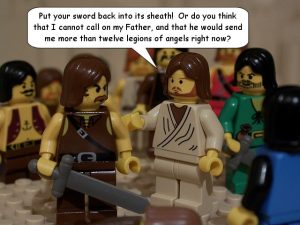
2)    Jesus directly rebukes Peter for actually using a sword just a few verses later.

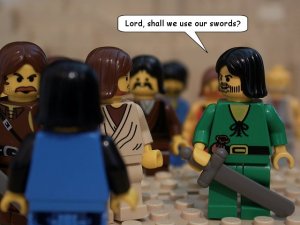
jn18_1049 When Jesus’ followers saw what was going to happen, they said, “Lord, should we strike with our swords?” 50 And one of them struck the servant of the high priest, cutting off his right ear.
51 But Jesus answered, “No more of this!” And he touched the man’s ear and healed him.

In a similar telling of the story found in John 18:10-11, Jesus actually responds to Peter’s violence with a blatant rebuke.   Certainly Jesus wouldn’t contradict Himself this blatantly by arming his disciples for an impending battle and then just a few verses later when the conflict arises (apparently in the form of self-defense) condemning them for using the weapons!

3)    Jesus openly declares he is not leading a violent rebellion.  In the very next verse!

52 Then Jesus said to the chief priests, the officers of the temple guard, and the elders, who had come for him, “Am I leading a rebellion, that you have come with swords and clubs?

jn18_11Jesus makes it very clear to the people around him that he is in fact doing the opposite of what many today assume that he is doing in this section!

4)    Jesus is likely referring only to the fulfillment of Scripture.

37 For I tell you, this scripture must be fulfilled in me: ‘And he was numbered among the lawless’; and indeed what is written about me is being fulfilled.”
38 They [the disciples] said, “See, Lord, here are two swords.”
“It is enough,” he replied. (NRSV)

Jesus quotes Isaiah 53:12 saying that he is destined to be arrested as a criminal.  In Jesus day, criminals carried weapons, and Jesus encourages the disciples to obtain these “props” in order to fulfill this prophecy.  Much like he has them obtain a donkey for his parade into Jerusalem to fulfill that prophecy.  Thus Jesus needs only TWO swords to satisfy this need.

This section is about the fulfillment of prophecy, not an empowerment of disciples to physical violence.   To suggest otherwise, makes Jesus out to be a rather incompetent military general.  =)

Matthew 10:34

Again, the greater context of this verse is key to understanding Jesus’ statement.

32 “Whoever acknowledges me before men, I will also acknowledge him before my Father in heaven. 33 But whoever disowns me before men, I will disown him before my Father in heaven. 34 Do not suppose that I have come to bring peace to the earth, but a sword. 35 For I have come to turn
a man against his father,
a daughter against her mother,
a daughter-in-law against her mother-in-law—
36 a man’s enemies will be the members of his own household [Mic. 7:6]
37 Anyone who loves his father or mother more than me is not worthy of me; anyone who loves his son or daughter more than me is not worthy of me; and anyone who does not take up his cross and follow me is not worthy of me. 39 Whoever finds his life will lose it, and whoever loses his life for my sake will find it.”

1)    Jesus is not talking about a literal sword.   Many times Jesus speaks in a non-literal fashion to add emphasis.  For instance, he tells us to “gouge out our eye” if it causes us to sin and “cut off our hand” if it causes us to sin (Matthew 5: 29-30).   Surely he doesn’t mean for us to actually DO these things!  He is speaking in hyperbole.

lk14_262)    Jesus means that he will bring DIVISION to even our most cherished relationships.   Jesus uses strong hyperbole to stress the reality that following Jesus has a cost.  That cost includes alienating us from friends and even family when we choose to follow him and they do not.

Or apparently from other believers who are offended that we would dare to suggest that Jesus was a pacifist!  (hahahaha, take it easy, it’s a joke!)

Luke records the same words this way: (Luke 12:49-53)

49 “I have come to bring fire on the earth, and how I wish it were already kindled! 50 But I have a baptism to undergo [my death], and how distressed I am until it is completed! 51 Do you think I came to bring peace on earth? No, I tell you, but division. 52 From now on there will be five in one family divided against each other, three against two and two against three. 53 They will be divided, father against son and son against father, mother against daughter and daughter against mother, mother-in-law against daughter-in-law and daughter-in-law against mother-in-law.”

The proper way to interpret Scripture is to let verses clarify other verses, particularly parallel passages. And now Luke 12:49-53 confirms the non-literal interpretation of Matt. 10:34. Jesus did not endorse physical violence against one’s own family, but he warns people about possible family division.

Matthew 21:12-15

And finally, the one that makes the very least sense to me in the context of this whole discussion…

12 Jesus entered the temple courts and drove out all who were buying and selling there. He overturned the tables of the moneychangers and the benches of those selling doves. 13 “It is written,” he said to them, ” ‘My house will be called a house of prayer,’  but you are making it a den of robbers.'”
14 The blind and the lame came to him at the temple, and he healed them. 15 But when the chief priests and the teachers of the law saw the wonderful things he did and the children shouting in the temple courts, “Hosanna to the Son of David,” they were indignant..  (TNIV)

jn02_15bThis story is often quoted as an example of Jesus employing physical violence to achieve his goal.  And though I am of half-a-mind to not even mention it for the lack of credible support of this view, I suppose we may as well discuss it.

There is absolutely no reason to read this story with any understanding that Jesus performs physical violence on other humans.   Certainly he creates a commotion, but he is not endorsing or engaging in violence as a solution to anything.  Here are several better ways to understand this passage:

1)    Jesus as involved in civil disobedience.  Jim Consedine puts it this way,

“. . . . there is another way of looking at this episode that is more consistent with the rest of his teachings. Seen as an act of civil/religious disobedience, similar to that conducted by Te Whiti and Tohu, Mohandas Gandhi, Martin Luther King and Ploughshares activists centuries later, it makes much more sense . . . . . . All of these people acted from religious outrage and disrupted civil processes, similar to the way Jesus acted. All are recognized internationally as leaders of non-violent direct action and role models of non-violent living.  So should Jesus be.”

Jesus neither harms people nor animals, but is creating a form of active protest toward the religious leaders.  This will be a great point of reference as well look into a future post on how Christians can be ACTIVE and not passive as we embrace a lifestyle of non-violence.

mk11_15b2)    Jesus as a Preacher.  Just as Hosea marries a prostitute to make a strong preaching illustration, Jesus overturns tables to show his disdain for the sham that the religious leaders have made of worship for God.   It is tantamount to a dramatic sermon illustration.  In the pattern of the prophets, he condemns the religious authorities.  In fact, this is a method of preaching that would have been understood and commonplace for His Jewish culture.

3)    The Jewish leaders are apparently not offended by any “violence” done against the moneychangers, but toward Jesus’ upsetting of their structures and His ministry to the blind, lame, and children.

Jesus has overturned the position of their tables and welcomed the less honorable (by their standards).   His act of civil disobedience is aimed at flipping the status quo.  Had he injured the moneychangers they would have had reason to arrest him, and yet instead despite their anger with him, they are unable to do so and he leaves unhindered.  In light of the religious leaders looking for any reason to arrest Him, the fact that Jesus leaves the scene “un-chained” is a strong indication that he does not “harm” anyone.

Now, if you are still hanging in there through this long post (certainly our longest of the series), then I commend you.   There are certainly many ways of understanding each of these stories that fit with the context of Jesus many other words of non-violence.

We’ll pick up next time on how the early church fathers and the Christians immediately following Christ interpreted and understood him on these issues.

Keep thinking!

(thank you to “The Brick Testament” for the great pictures!)

Waterboarding for Jesus?

waterboardingTaking another quick break from our discussion of non-violence, I thought I would throw in a recent survey done by the research of the PEW FORUM.   It is a survey that has been passed around a lot for the last two weeks, but is worth mentioning here in the context of our discussion.
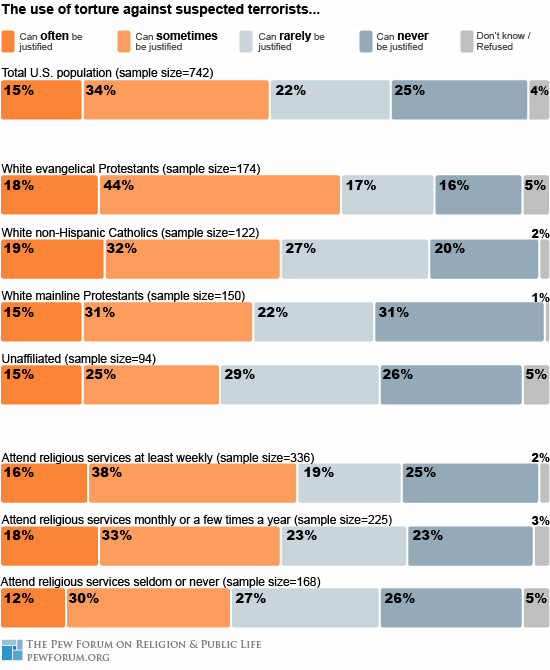
If you haven’t seen it, then let me warn you… it isn’t pretty.  I mean, torture of course isn’t pretty (though I wonder if most people in this study have thoroughly thought about its appalling reality), but uglier still is the statistics on its acceptance among regular church-goers.

The survey shows that 62 percent of white evangelicals believe torture of suspected terrorists is “often” or “sometimes” justified.  A total of 79 percent of the same group were “okay” with torture if pushed far enough.

And, maybe most disturbing, those who attend church regularly were more likely to rationalize and justify torture than those who do not go to church.

SERIOUSLY?  Something is definitely perplexing when the “body of Christ” is the expert at the rationalization of torture, for any reason.  What’s next?  Waterboarding for Jesus?  An argument for a “just war” theology is one thing, but the use of torture (even on those who are guilty of atrocities) would surely seem to go far beyond even those guidelines.

I’d be interested to hear how other Christians in favor of these methods justify this “utilitarian ethic” in light of Jesus.  I would hope that the response would be something more Christ-like than a simple, “the ends justify the means.”  I welcome your comments with any rationalization that makes an attempt to address Scripture on this topic.

We’ll continue on with our discussion next post (though this topic is clearly related) but take a look at these statistics and see if they look anything like what the followers of the Christ, who was Himself tortured and killed, should endorse.  It appears to be a very sad commentary, I’m afraid, of American Christianity’s syncretism with national idolatry and military power.

For another good article on this study click on this short Christianity Today blog by Skye Jethani.

torture

For another good article on this study click on this Christianity Today blog by Skye Jethani.

God’s Character in Reverse

Welcome.  We are in a little discussion series on whether or not Christians should be involved in violence for any reason.  I’m assuming that most Christians believe that unprovoked violence is wrong, so we will be spending most our time thinking about national violence (military), self-defensive violence (fighting or killing only when your own life is in jeopardy), and protective violence (done to protect another person).

It is a discussion that, apparently, is controversial for many people, especially Christians.

pacifism1Which, I admit, is kind of strange to me.  I obviously expect that many Christians are pro-national violence (at least as it relates to their own country), however it somewhat surprises me that these people are so vehemently opposed to the suggestion that Christ calls us to a life of non-violence.  I understand the general disagreement.  But, were I just to read the Gospels (the story of Jesus), I would assume the controversial issue would be that any Christian might actually think that violence of any kind was okay.

All that to say, from everything we know about Jesus, it seems weird to me that the non-violent position is in the minority, at least in Western Christianity.  But, I suppose that is why we are having this discussion in the first place.  And as Memorial Day approaches, it is a good time for us to think through these issues more fully.

Now there are many Scriptures that are debated and scrutinized in this dialogue, and we will be looking at these texts over the next several days.  Many of these surround God’s involvement in the nation of Israel’s military violence in the Old Testament.   Also, there are many philosophical challenges to Jesus’ way of non-violence that are often mentioned and we will deal with those as well.

However, I’d like to have us start by laying a foundation for all of this discussion somewhere else, before we dig into the rest of the arguments.  So, put aside all of this anxiously awaited fodder and lets begin somewhere more broadly.

In this post, then, I’d like us to look at where we gather our primary pictures and assumptions of God’s character.  In other words, what is our main source for knowing what God is actually like?

Youth pastors, preachers, and well-meaning leaders have told me since I was very little that I get to know who God is best through the Bible.  And while I have found this to be quite true, I have also found that it was not quite specific enough.  Through the Bible, God gives his very specific direction on how to know who He is and what He is like.

Let’s take a look at this direction:

reading-bible-blueIn Christ all the fullness of the Deity lives in bodily form”  (Colossians 2:9-10)

Jesus answered: “Don’t you know me, Philip, even after I have been among you such a long time? Anyone who has seen me has seen the Father. How can you say, ‘Show us the Father’?  (John 14:9)

He is the image of the invisible God, the firstborn over all creation.” (Colossians 1:15)

“No one has ever seen God, but God the One and Only (Jesus), who is at the Father’s side, has made him known. (John 1:18)

In other words, God says, “you want to know who I am and what I am like?  Okay, here I am.  I am exactly like this.  Like Jesus.”   He even goes so far as to say that Jesus has made God known, as if until Jesus we didn’t fully know who God was.  Apparently, as good as the stories in the Old Testament are, they didn’t reveal God adequately.

Only the Incarnate Son is an appropriate full-picture of God.

The writer of Hebrews (whoever she was) put it most directly like this:

1In the past God spoke to our forefathers through the prophets at many times and in various ways, 2but in these last days he has spoken to us by his Son, whom he appointed heir of all things, and through whom he made the universe. 3The Son is the radiance of God’s glory and the exact representation of his being, sustaining all things by his powerful word. After he had provided purification for sins, he sat down at the right hand of the Majesty in heaven.  (Hebrews 1:1-3)

Did you catch that?  (I hope so; I underlined it and made it bold).  Jesus is the EXACT REPRESENTATION of God’s being.  Nothing defines God like Jesus.  He is not an approximate picture of God, or just one side or facet of God.  He is not the non-violent side of an otherwise “just war” God.  He is the EXACT REPRESENTATION.

hagia_sophia_vestibule_christ_mosaicNow, because Jesus is the fullest picture of God, when it comes to the Bible, I am compelled to read everything through the eyes of Jesus.   As this applies to our discussion at hand, it means that I must fit any violent stories of the Old Testament (which are problematic) into what I know of Jesus as revealed in the New Testament, not the other way around.

For instance, many people read stories in the Old Testament and glean what they perceive are “attributes” or “characteristics” of God from these stories and then apply them to their picture of Jesus.   In this case, since God involves himself in the violent battles of the Israelites, then we assume that this “necessary violence” is something Jesus would condone (even if it apparently includes mass infanticide and genocide).

However, when God directs us to know Him through Jesus most perfectly, we are called to learn His character backwards.  We learn what God is like by observing and studying Jesus and then read backward through the Old Testament through His lens.

Whatever these violent stories may mean (some are more confusing than others), through the primacy of Christ we regard them as an incomplete and inadequate picture.  Where they contradict what we see in Jesus (war, genocide, even self-defensive violence), we embrace Jesus’ way as the EXACT REPRESENTATION of God, and find some other way to make sense of them.

Interestingly, I believe this is why Jesus’ time on this earth was so long.   Certainly the death of Jesus was important in freeing us from the bondage of our brokenness, but his life was equally as important.  For in his life, and ultimately in his self-sacrificial manner of death (the final exclamation point to how we should respond to violence), God demonstrates his character and what he desires.  He lives and interacts with people and finally dies non-violent in the face of violence to show THE EXACT REPRESENTATION of God.

The problem of violence in the Old Testament is admittedly uncomfortable, but however these scenes are explained, as followers of Christ we are compelled to not use them to create pictures of God that are contradictory to what we plainly see in Jesus.

Ok.  That’s enough for today.  We’ll jump into some more tangible parts of the discussion in the next post.

Happy Thinking…