

Need something stimulating to think about?
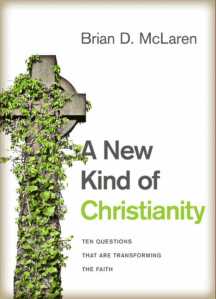
You could hardly go wrong with Brian McLaren’s new book, “A New Kind of Christianity.”
This book is certainly continuing to stir up not only healthy dialogue about important topics of faith, but also controversy in the Christian arena. It seems that there is very little middle-ground of opinion in regards to this book. People tend to either love it or hate it. And like it or not, in Christian circles this book looks to be THE “most talked-about” read of the year.
So, why endorse something that is the source of such controversy? Well, for several reasons:
1) WE NEED TO BE AWARE OF THE DISCUSSION.
Lots of people will be talking about this book and the questions that it raises. And make no mistake, they are important questions, no matter what you think are the correct answers. These are the questions of 21st century Christianity; questions of both those inside and outside the mainstream church today. Whether you realize it or not, you will be a part of this discussion. In fact, your voice will help shape this discussion.
And let me suggest that you actually read what is being stated by this intriguing side of the discussion. I have and will continue to read many disparaging comments and blogs about Brian McLaren’s view from people who disagree with his answers, which by the way is just part of the healthy dialogue. But, what is not healthy is that many of the people on the opposite side of the debate have not actually read McLaren’s books.
“That Brian McLaren has really gone off the deep end. I think he’s dangerous.”
“Have you read his book?”
“No, but I’ve heard he said such and such.”

Brian McLaren
Maybe we ought to be a bit more informed as we enter this discussion. Whether it is McLaren or MacArthur, maybe we should actually LISTEN to what they have to say and the context in which they say it before we criticize them. In fact, while you may disagree with either person in many areas, you may find some common ground as well. Or perhaps even more importantly, you may disagree with the conclusions, but may find a respectful appreciation for the spirit of the person and their questions.
In a recent interview, McLaren makes a case for this in responding to the way people easily dismiss his questions as “liberal” without considering his possibly more complex stance:
“I wouldn’t want to overlook the many ways in which my proposals differ from traditional liberal theology. My attitudes and commitments regarding Jesus, the Holy Spirit, scripture, spiritual experience, institutionalism, personal commitment and conversion, evangelism and discipleship, and many other subjects make many of my liberal friends think of me as conservative. Sometimes I wonder if evangelicals simply use the word “liberal” as a way to say, “Let’s stop listening to this person. He’s too different from us, and so is not worth our time and attention.” I hope that’s not the case, but sometimes, this is what I feel like when evangelicals use “the L word.”
For me, liberal is not automatically a bad word. If liberal means free from tyranny, I’m for it. If liberal means generous, I’m for it. If liberal means believing that our best days are ahead of us, I’m for it. If liberal means welcoming honest questions and giving honest scholarship a fair hearing, I’m for it. If, on the other hand, liberal means without restraint, or careless about tradition, or dismissive of scripture, or institutional and lukewarm regarding commitment to Christ, and so on, then I wouldn’t want to be associated with that. And we could say parallel things about the word conservative.”
Huh, maybe he’s not as crazy as people say. But, that’s not important. You don’t have to agree with McLaren, but maybe we should give him a fair-hearing (or rather reading). It may be that he is not as “off-the-deep-end” as we think. Or even if he is, that he is at least still committed to the best of his mental and reasoning ability to Jesus, if only incorrect.
2) WE NEED TO BE THINKERS
What I like best about this book is that it forces us to wrestle with concepts we take for granted and THINK. Controversy can only exist where people are seriously grasping and thinking and reasoning. And in that way, a healthy dose of controversy is probably very good for the modern church.
I work with high school students on a regular basis, and by far my greatest goal in my time with them is not to give them all the answers. Do I want them to have good answers? Of course. But more importantly, I want them to learn HOW to question, HOW to find good answers. I want to help them learn HOW to THINK. Many more questions will come up in their lives long after I am gone, and I’d rather they learned how to critically think about those questions sure-to-come in the future rather than just have some spoon-fed responses from me about the ones they are asking right now.
Ironically, many high schoolers I know are better at wrestling with questions and learning to think than a lot of adults. And maybe that is a bigger problem in our churches today than we’d care to admit. We just don’t think for ourselves. We’ve accepted long-held answers (many of which might be correct, by the way) to many old questions (some of which people aren’t asking anymore) without ever thinking it through ourselves. We are lazy. Lazy theologically. Lazy mentally.
This has direct consequences for our witness to the world. Because while we are busy being content with answers to questions we’ve never genuinely asked ourselves, the rest of the world is actively and honestly seeking answers. The church is irrelevant because by and large we can’t speak authentically to these questions. We appear to be a second-hand, consignment store of truth because we are primarily selling the “hand-me-down responses” of generations before us rather than doing the hard work of wrestling with the deeper questions and making sense of them in this time and context for ourselves.
Consider just these few questions: How is the Bible unique and why should it apply to my life? What makes the Bible authoritative in my life? How do I know it is the “Word of God?” What does it mean that it was “inspired?” What in the Bible is culturally-conditioned for people at the time of it’s writing and what is a universal-truth that applies to me? How do I know the difference? Can I know the difference? Is there a difference?
While just the tip of the proverbial ice-berg, these questions alone go a long way in helping answer modern dilemmas such as human sexuality, the character of God, the purpose of Jesus, social justice, and other ethical considerations.
 Some will agree with the conclusions of the author and others will not. But no matter what you think of McLaren’s answers, what is undisputable is that these questions need to be asked. Or rather, these questions are already being asked by many people (friends, family, co-workers) around us. McLaren is not by far the first person to ask these questions, but he is suggesting that rather than dismissing the people who ask them maybe we ought to spend some time struggling with them as well and as a community “led by the Spirit” recalibrating the answers to this time and in our current context.
As McLaren says:
“That’s why, in the end, I hope people will actually read the book with an open heart and mind. I’m not expecting that anyone will agree with everything — that’s not my point. But I am hoping that people will be stimulated to think, and maybe even to dream of better possibilities … so the Christianity of the future can continue to learn and grow and not simply repeat the past or be stuck in the present.”
Is it dangerous to read a book that challenges things that you believe and causes you to ask some rather unsettling questions about your core beliefs? Possibly. But far more dangerous for the church today is not reading these books and not asking these inquiries.
So go ahead and risk it. It’s okay to hang up the “under-construction: please come back later” sign on your theology for the weekend. Pick up the book and let it mess you up a little bit. Be okay to let the questions move you to a place of uncertainty for a while. Inhale the ambiguity and breathe deep the tension of inquisition.
It may be that once the smoke and fog has cleared you find yourself with some “real” answers. Or at the very least, a greater understanding & compassion for and a stronger, more respected voice into the life of seekers around you.
It could be the church will be healthier for the controversy.
 We have FIVE final questions from this last Sunday, and I will be responding to THREE of them in today’s post followed by the last TWO tomorrow.
 My point at the beginning of the message is that it we should pick up the “rebellious spirit” of the 1960’s “flower children” and as people who follow Christ be willing to be counter-cultural. Instead of mindlessly buying into what our cultural tells us love is about, we should approach relationships with the radical “choice” and “sacrifice” oriented love of Jesus.
 Secondly, even though you feel like it, you aren’t the “only one” left out there that is still a virgin. In fact, over the last few years, lots of studies have shown that the statistics of high school students waiting until later to have sex is going up. One recent study showed that 40% of all high school students will graduate without even having had an intimate date!
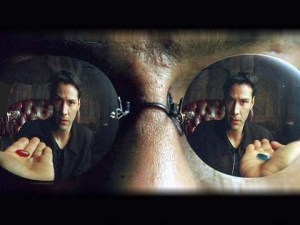 And so, maybe your perspective helps them see relationships differently. Maybe you can be like Morpheus in “The Matrix” and help them see what they couldn’t about love because all they knew was what they were culturally programmed to see.
 Well, here we are in our last couple weeks of this series, “Love Connection” and I think it has been kind of fun. Hopefully you have too. I know we still have much to learn about our relationships with each other, and yet I think we’ve learned a bit along the way. Hopefully this conversation will remain as a record of our time here.
 So what does the bible teach us about dating? Very little. In fact, the Bible doesn’t really prescribe any particular way that people should date, court or be “arranged” for marriage.
 This is a good question because many people start dating-from-afar. Sometimes the physical distance between people is over many states or countries. But, in another way, physical distance can be almost as far if you live in the same county but go to different schools and rarely see each other.
 However, while there are some benefits (in theory) there are also some drawbacks. People living away from each other don’t have the opportunity to experience the other person in “real life.” There is only so much you can learn from phone calls and late-night text messages. Who a person is on the phone and who they are in everyday life with their family and friends may be very different.
 Ok. Let’s see what we can make of this. It is a legitimate question; especially for someone at your phase of life. So, let me just say a few things.
 As an example: when I go to buy a new vehicle, I like to drive around to many different dealership lots and see what is out there. And before I get too serious about any of them specifically I want to go on a “test-drive”. Now, when I tell the salesman that I’d like to drive it and see how it handles, I don’t also promise to be faithful to that car and only that car. I don’t promise to love it and care only for it. I just tell him I wanna try it out. If it drives well, than maybe we can pursue it further.
 Now, I know people aren’t like cars. But, that actually strengthens my point. The boring biege Chevy Astro van isn’t going to be disappointed that in the end I choose the bright blue Toyota over it. (Btw, I would never drive an astro-van). But, people do get hurt. And we need to be careful about the commitments we make to people, especially at a young age when we aren’t ready to deliver on those large commitments anyway.
 This question, like one we had a few weeks ago, isn’t about romantic love (well, at least I hope it isn’t! Maybe in Arkansas it is! ☺ But, as Austin said on Sunday night, one type of love found in the Bible is between family members. So, I would like to respond to this one anyway.
 I love ranch-flavored sunflower seeds.
 The problem with both of these terms is they need defined. When someone says, “love” what do you think of? Love of what? Sunflower seeds? iPhone? And if love is hard to define, than what about the phrase, “being in love.” That one seems to have taken on a whole lot of fuzziness. No one is quite sure what it means. In fact, most people might tell you that it can’t really be defined at all. It isn’t something you can describe; you can only feel it.
 In essence, John says, “You wanna know what love is? Well, this is love. This is it right here. You know love because God, who is love, loved you. He defined love for you. But his definition can’t be found in a dictionary. Love isn’t made of words and feelings, but of actions. Love is a verb. And he demonstrated this action of love by not claiming his own rights and choosing to come and give up his own life for you, though you didn’t deserve it. In fact, before you even chose to love him.”
 Think of it this way. How do you know when you are really going down a water-slide at Wildwaves? Well, I don’t know about you, but I know I’m going down the slide when I choose to do it and push off and head on down. In other words, I know my decision pretty quick. Either I’m yelling and screaming down a winding tube full of raging water or I’m not. (I just wonder how many kids have peed in the pool at the bottom!).
 I mean, we make choices all day long and don’t question it. I don’t start eating my subway sandwich and think, “How do I know that I’m really eating lunch?” (Some philosphers might, Rene Descartes wanted to know how to know he really existed!) I know I’m eating lunch because I’ve decided it is noon and I’m hungry and that I’m going to eat now (which actually sounds like a good idea, cause all this food talk is making me hungry).
 I was watching the “Today Show” on TV a few weeks ago and I saw an interview with Jenny McCarthy (previously from MTV). She was talking about her relationship with Jim Carrey (they have been a couple for years now, but are opposed to marriage). Here is what she said about the suggestion that they get married eventually: “We’re living together… and we’re very happy – all that’s going to be is a piece of paper, really.”
 Now, let’s think this through a bit. As I responded in “Question 2” of the last post, there is no thought of “pre-marital” sex in the Bible. In the Jewish culture, sex was either an act done in the relationship of an existing marriage, or was the basic form of solidifying a new one. So, if you weren’t married and happened to have sex with a beautiful girl you met at the grocery store, guess what? Now you are married! Sex, in the Bible, has very large social and spiritual responsibilities as well as individual ones.
 1) Parents are some times wrong. I have a feeling probably even your parents would agree with this. Many times they may have something that they feel is very important for you to know, do, learn, or be a part of, but they make mistakes in how they push you towards it. Their motivation is good, but their execution is less than perfect.
 So, today I am starting a bit of brief new direction in some of my blog entries. Our high school group is currently involved in a series called, “Love Connection” where we are looking at the amazing beauty of the romantic relationships God has created us to need and enjoy.
 I think some people who are not involved in meaningful relationships are jealous of those that are. And although that jealousy might be very malicious, it doesn’t have to be. I think that some people look at the relationship of others and think, “I want what they’ve got.” They may not want to hurt anybody. They may simply just want to experience the goodness of that relationship. And maybe part of the thought process is that if they can somehow hijack that relationship that they will get to experience the same things. Sadly, I think it doesn’t usually work out this way. Relationships that start with deception in their beginning have built that deception into their DNA and trust and genuine love will have large hurdles to overcome.
 In one of my favorite movies, “Wedding Crashers,” Owen Wilson’s character gives this definition of love; “Love is the soul’s recognition of it’s counter-part in another.” He is describing this idea of “soulmate”. And while I love that movie, I disagree with it’s definition of love.
 In the book of Hosea, God tells his prophet, Hosea, to go and marry a prostitute. And so, strangely, he does. But, as you could imagine, the relationship doesn’t go so well. She is unfaithful; she cheats on him, and eventually leaves him. And so God then tells Hosea, “Go, show love to your wife again, though she is loved by another and is an adulteress.” And God’s reason for doing this? “Love her as the Lord loves his people.” – Hosea 3:1 (TNIV)
 nickloyd.com